17 Modern Laundry Room Ideas That Make Chore Time Feel Less Like a Chore
Published: 21 Sep 2026
A laundry room is one of the most functional spaces in a home, but that does not mean it has to look purely utilitarian. Modern laundry room ideas work well for anyone tired of a cramped, purely functional setup with bare machines and no real storage, offering ways to add genuine style and organization to a room that gets used nearly every day. Many of these ideas also solve real functional problems, from folding surface shortages to visible clutter, in addition to their visual upgrade. This guide covers 17 modern laundry room ideas for every space and budget, from cabinetry and storage to layout solutions for small spaces. Along the way, you will find honest pros and cons, real price ranges, a materials and layout comparison table, maintenance advice, and answers to the questions people search most before updating a laundry room. By the end, you will know exactly which ideas fit your space, your budget, and how your household actually does laundry.
Is a Modern Laundry Room Update Right for You?
A laundry room update can range from a few organizational accessories to a full renovation, so it is worth weighing the trade-offs honestly based on how the space is actually used.
Pros
● High daily functional impact — because laundry is a frequent, recurring task, improvements to the room’s layout and storage have an outsized effect on daily convenience.
● Solves common clutter and storage problems — dedicated storage for detergent, hampers, and supplies keeps this clutter contained rather than spreading into hallways or other rooms.
● Adds resale value — a well-designed laundry room is increasingly cited by buyers as a meaningful selling point, particularly when it includes genuine counter and storage space.
● Can be phased affordably — smaller elements like shelving, lighting, and storage bins can be added individually without committing to a full renovation all at once.
Cons
● Full renovations carry real plumbing and electrical costs — moving a sink, adding a folding counter over existing machines, or updating ventilation typically requires licensed trades.
● Small laundry rooms limit layout options — a narrow closet-style laundry space may not accommodate a full counter, sink, or significant additional storage without creative solutions.
● Ventilation and moisture require careful material choices — cabinetry, flooring, and countertops near a washer need materials suited to consistent humidity and occasional water exposure.
● Hidden laundry solutions add complexity — pocket doors or cabinet-concealed machines look polished but can complicate maintenance access and ventilation if not planned carefully.
For most households, a laundry room update is worth prioritizing, starting with storage and counter space, since both directly address the most common daily frustrations, before considering larger investments like custom cabinetry or a layout change.
1. Floating Shelves Above the Washer and Dryer
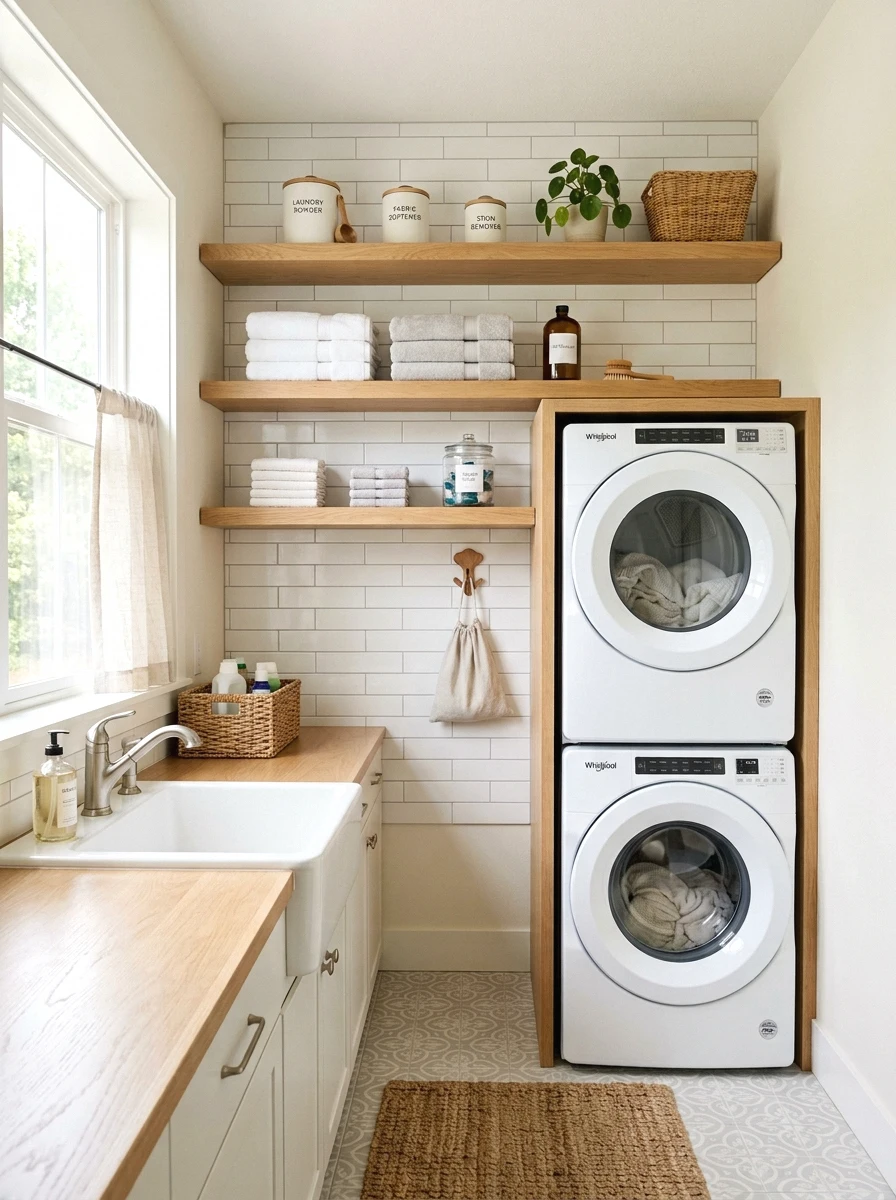
Floating shelves above the machines make use of vertical space that would otherwise sit empty, giving you a place for detergent, dryer sheets, and folded items without adding bulky cabinetry to a smaller room.
Choose shelves with a slight lip or edge, especially if storing bottles, since laundry rooms see enough movement and vibration from machines that unsecured items can shift over time.
Best suited for: smaller laundry rooms and closets without room for full upper cabinetry.
2. Built-In Cabinetry With Countertop
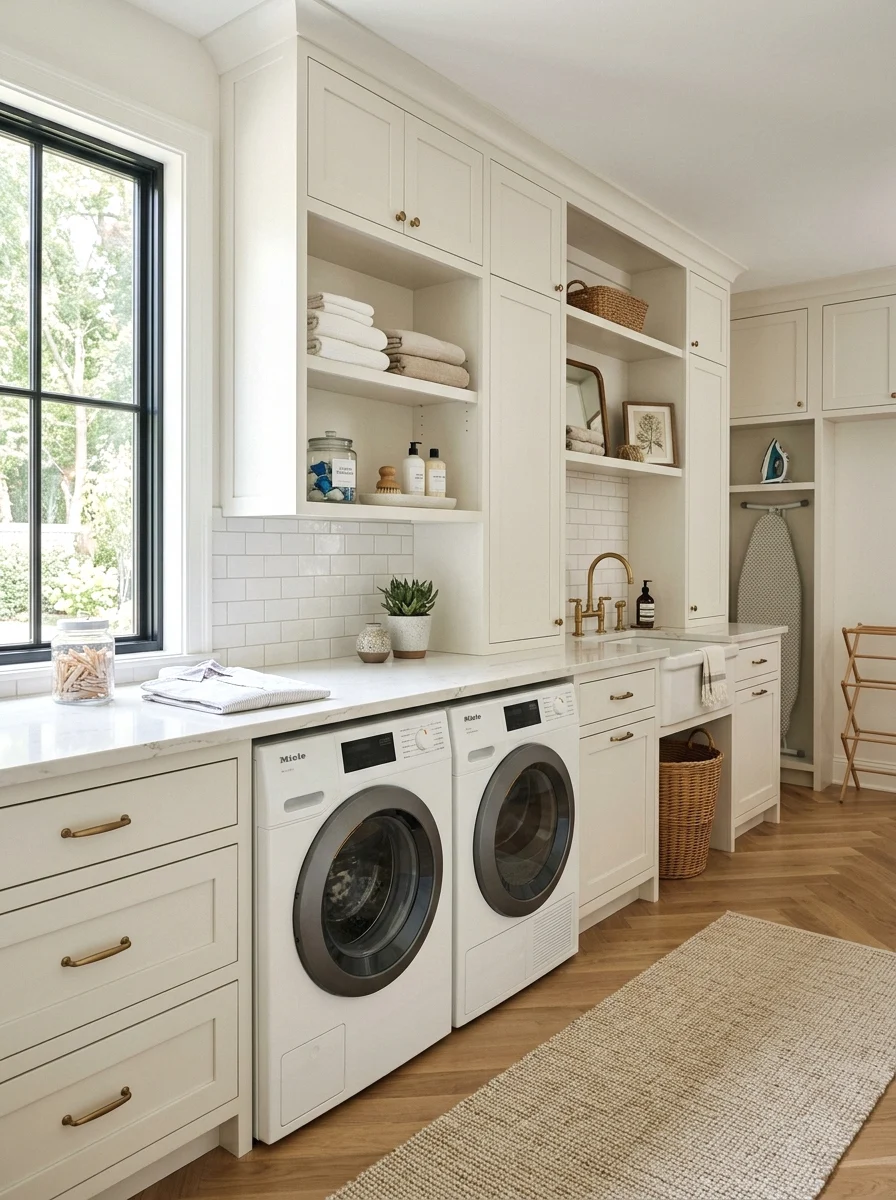
Full built-in cabinetry with a countertop gives a laundry room the same finished, custom quality as a well-designed kitchen, while providing genuine storage capacity and a proper folding surface that most laundry rooms lack.
Choose a countertop material rated for moisture exposure, like quartz or laminate with a sealed edge, since laundry room counters regularly encounter damp clothing and occasional spills.
Best suited for: full laundry room renovations and households wanting maximum storage and counter space.
3. Farmhouse Utility Sink
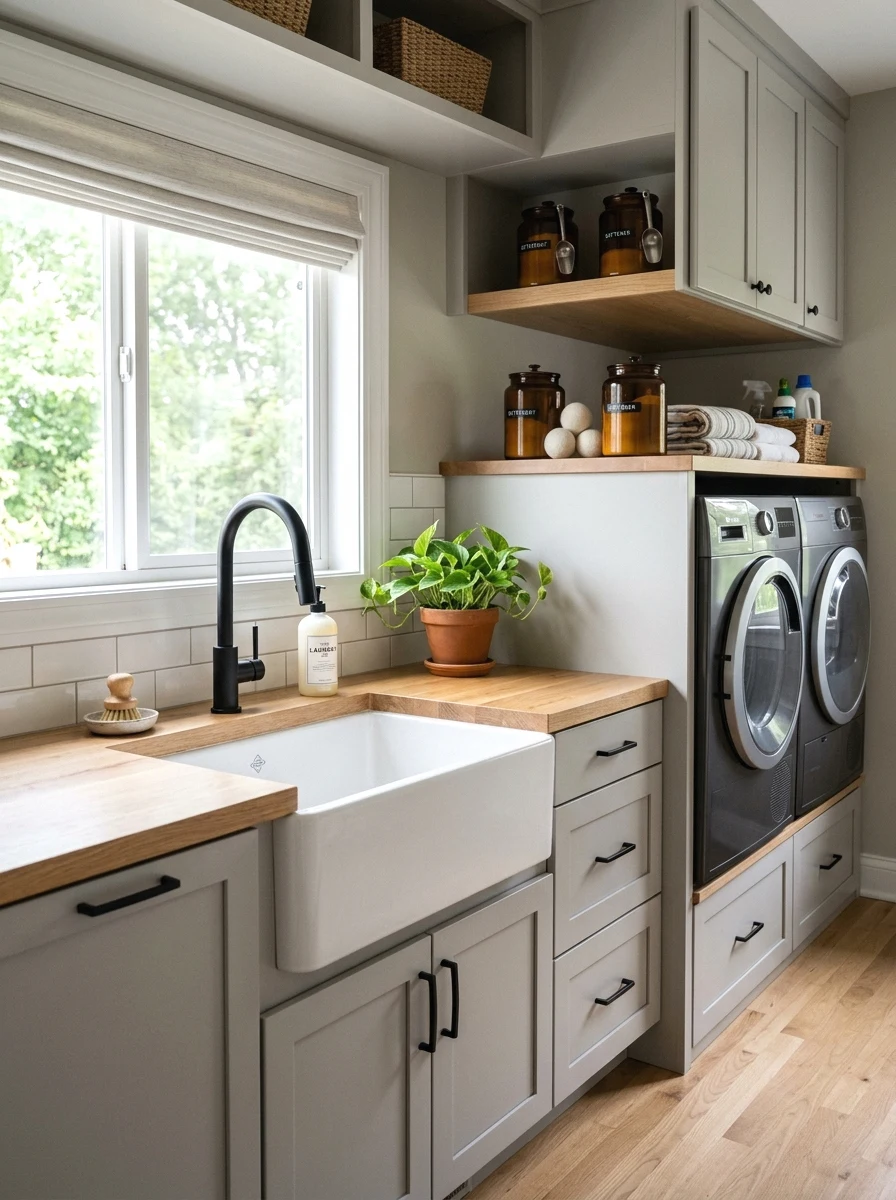
A farmhouse-style utility sink offers significantly more capacity than a standard laundry sink, making it genuinely useful for hand-washing delicates, soaking stained items, or even washing muddy boots and pet supplies.
Choose a sink material like fireclay or stainless steel specifically rated for utility use, since these materials better withstand the heavier daily use a laundry sink typically sees compared to a bathroom sink.
Best suited for: households doing significant hand-washing or needing a heavy-duty sink for tasks beyond laundry alone.
4. Open Shelving for Labeled Storage Bins
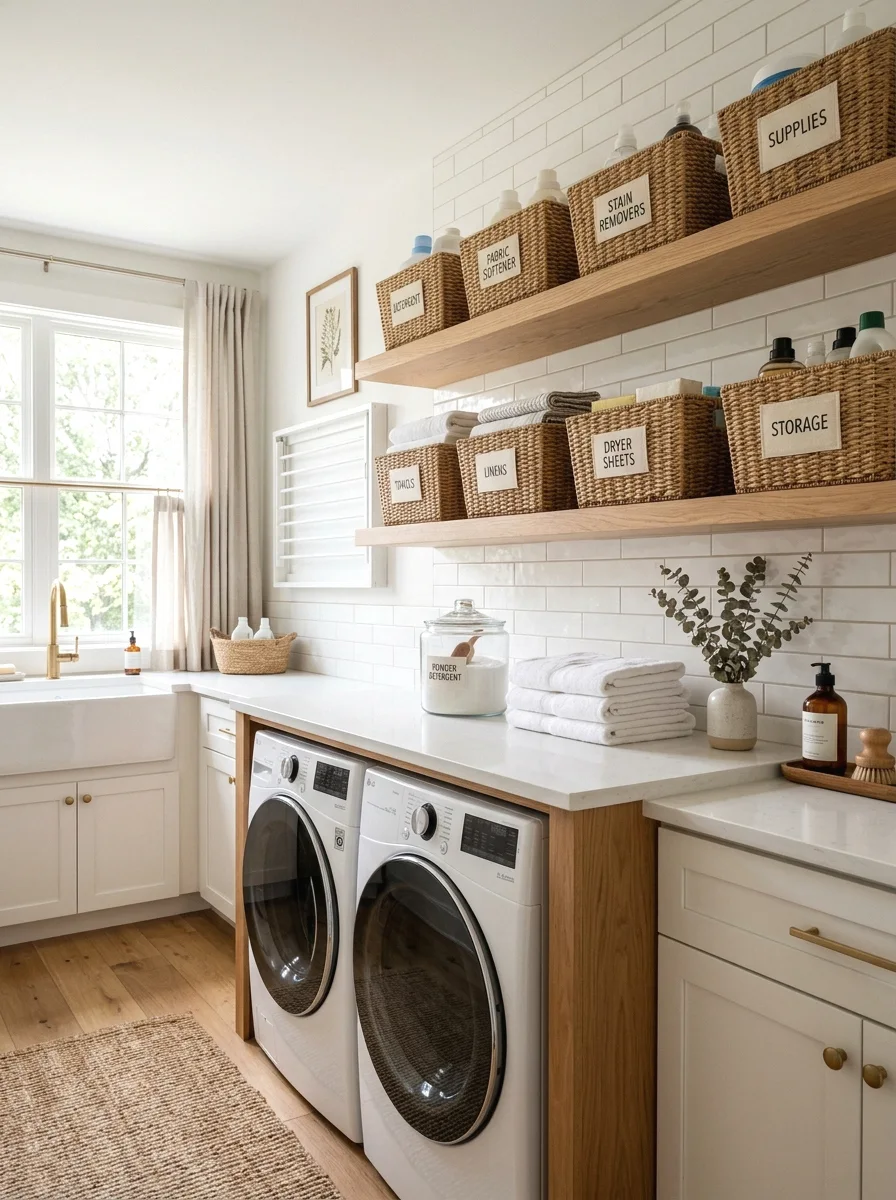
Open shelving with labeled bins keeps laundry and cleaning supplies visible and organized by category, which makes finding a specific item faster and helps prevent the room from becoming a catch-all storage space for unrelated clutter.
Choose a consistent bin size and label style across the shelving, since visual consistency alone makes even a fully stocked shelf look more organized and intentional.
Best suited for: any laundry room, and a relatively affordable way to add both storage and style.
5. Statement Tile Flooring
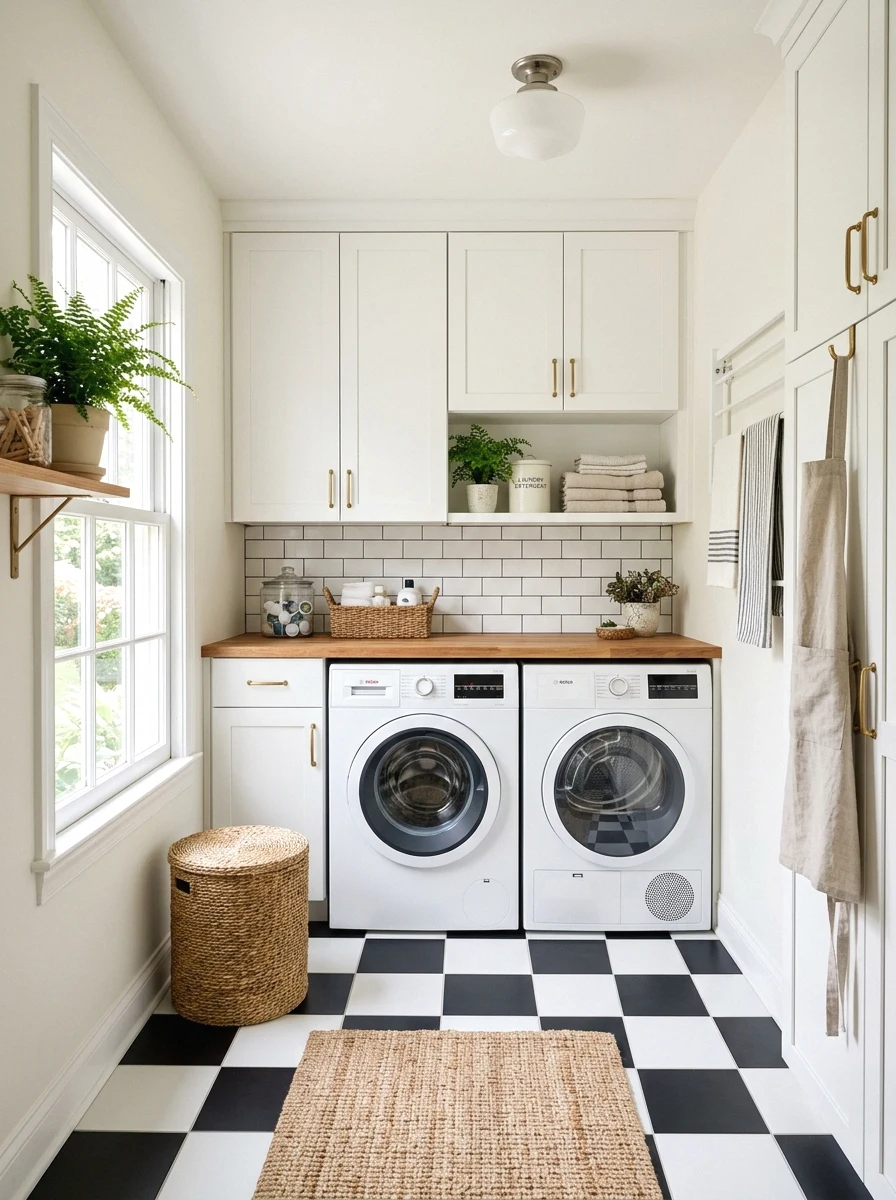
A laundry room is one of the best places in a home to introduce a bold patterned floor, since the smaller footprint means the pattern reads as a fun design statement rather than an overwhelming choice for a larger room.
Choose a durable, water-resistant tile like porcelain, and confirm proper grout sealing, since laundry room floors face more moisture exposure than most other rooms in the house.
Best suited for: laundry rooms with hard flooring being replaced, and homeowners wanting a bold, playful design element.
6. Hidden Laundry Behind Cabinet or Pocket Doors
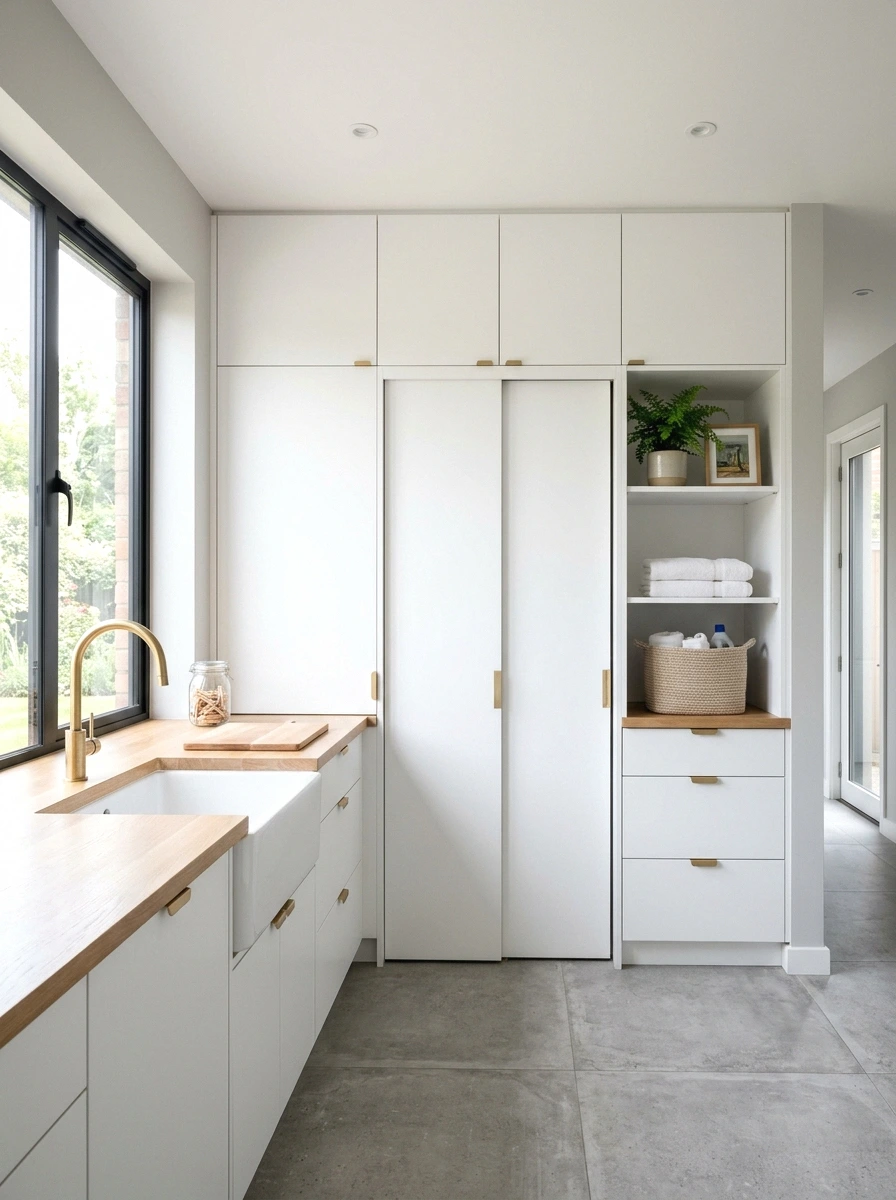
Concealing laundry machines behind pocket doors or cabinet fronts lets the room blend visually into an adjacent space, like a kitchen or hallway, which is especially useful when the laundry area is not a fully separate room.
Confirm adequate ventilation clearance behind closed doors, since concealed machines still generate heat and moisture that need somewhere to properly dissipate even when hidden from view.
Best suited for: laundry closets located within a kitchen or hallway, and homeowners wanting the machines fully out of sight.
7. Wall-Mounted Fold-Down Drying Rack
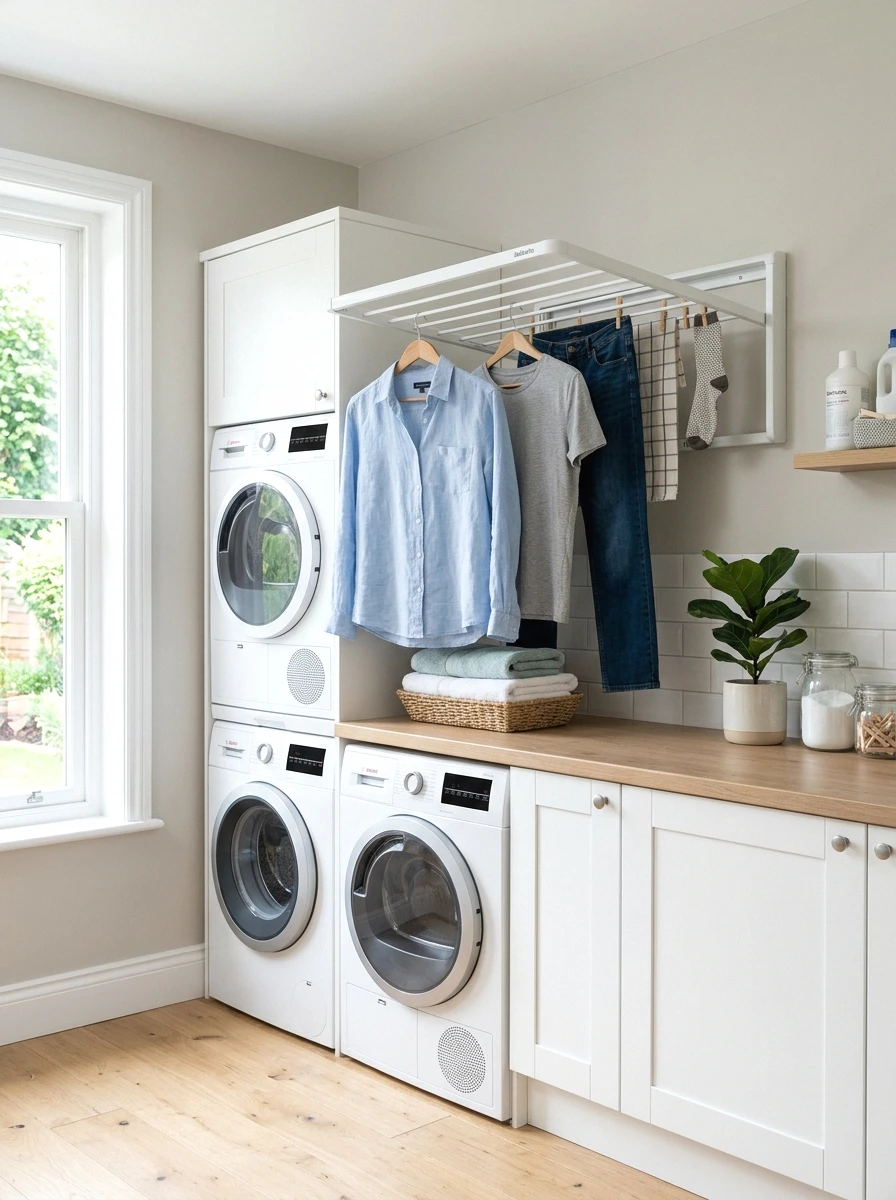
A fold-down drying rack that mounts flat against the wall when not in use solves the common laundry room space problem of a bulky standalone drying rack taking up floor space between uses.
Install the rack at a height comfortable for hanging items without excessive reaching, and choose a model with a weight rating suited to heavier wet garments rather than the lightest option available.
Best suited for: smaller laundry rooms and households that regularly air-dry delicate or specialty garments.
8. Hanging Rod for Air-Drying Clothes
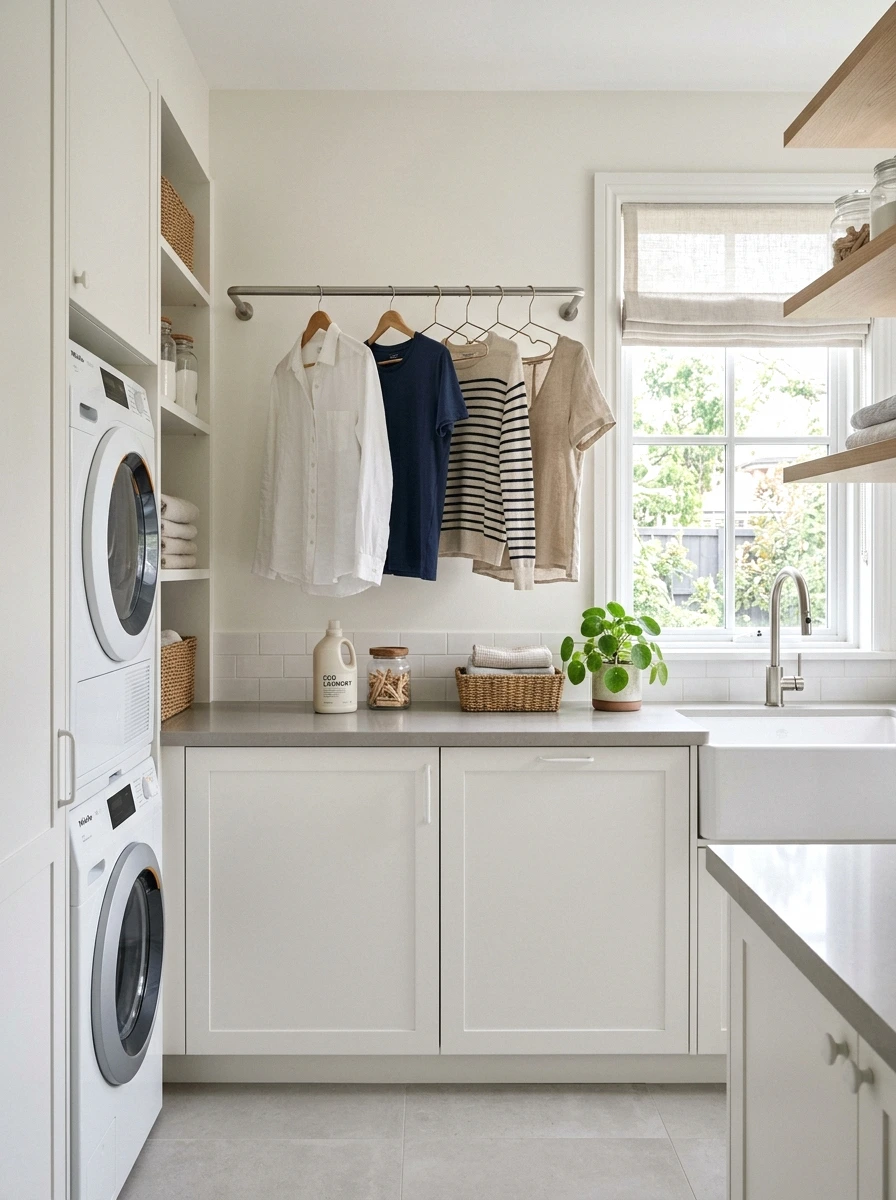
A dedicated hanging rod gives you a spot to hang garments directly from the wash, whether air-drying delicates or simply reducing wrinkles before a dryer cycle, without needing to set up a separate rack each time.
Position the rod with enough clearance below for hanging items to fully extend without touching the counter or floor, and mount it into a stud or use properly rated anchors given the sustained weight of wet clothing.
Best suited for: any laundry room, and a simple, low-cost functional addition.
9. Bold Wallpaper Accent
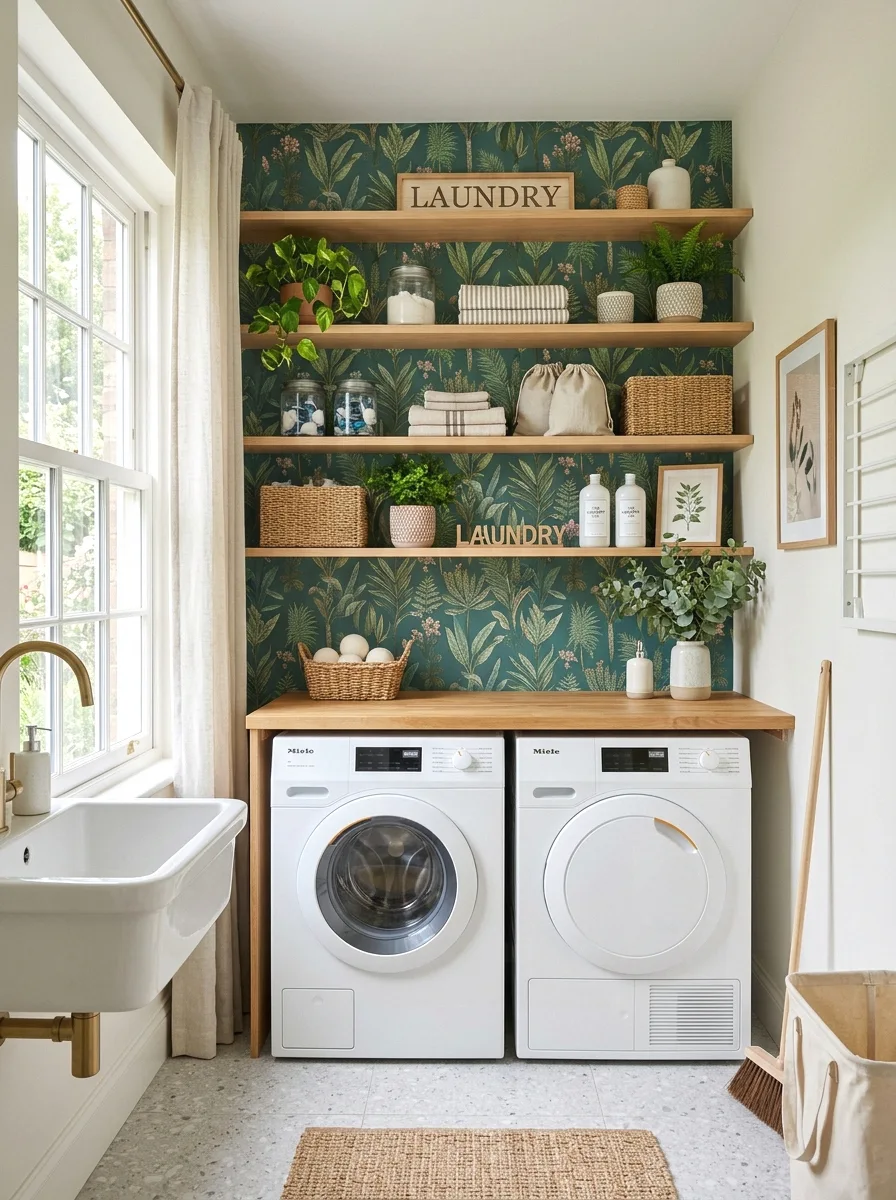
A laundry room’s smaller footprint makes it an ideal spot for bold wallpaper that might feel overwhelming in a larger room, giving the space genuine personality despite its purely functional purpose.
Choose a moisture-resistant, washable wallpaper specifically rated for humid environments, since laundry rooms experience more consistent moisture exposure than most other rooms where wallpaper is typically used.
Best suited for: laundry rooms wanting a bold design statement, and a relatively low-cost way to elevate the space.
10. Pull-Out Hamper Drawers
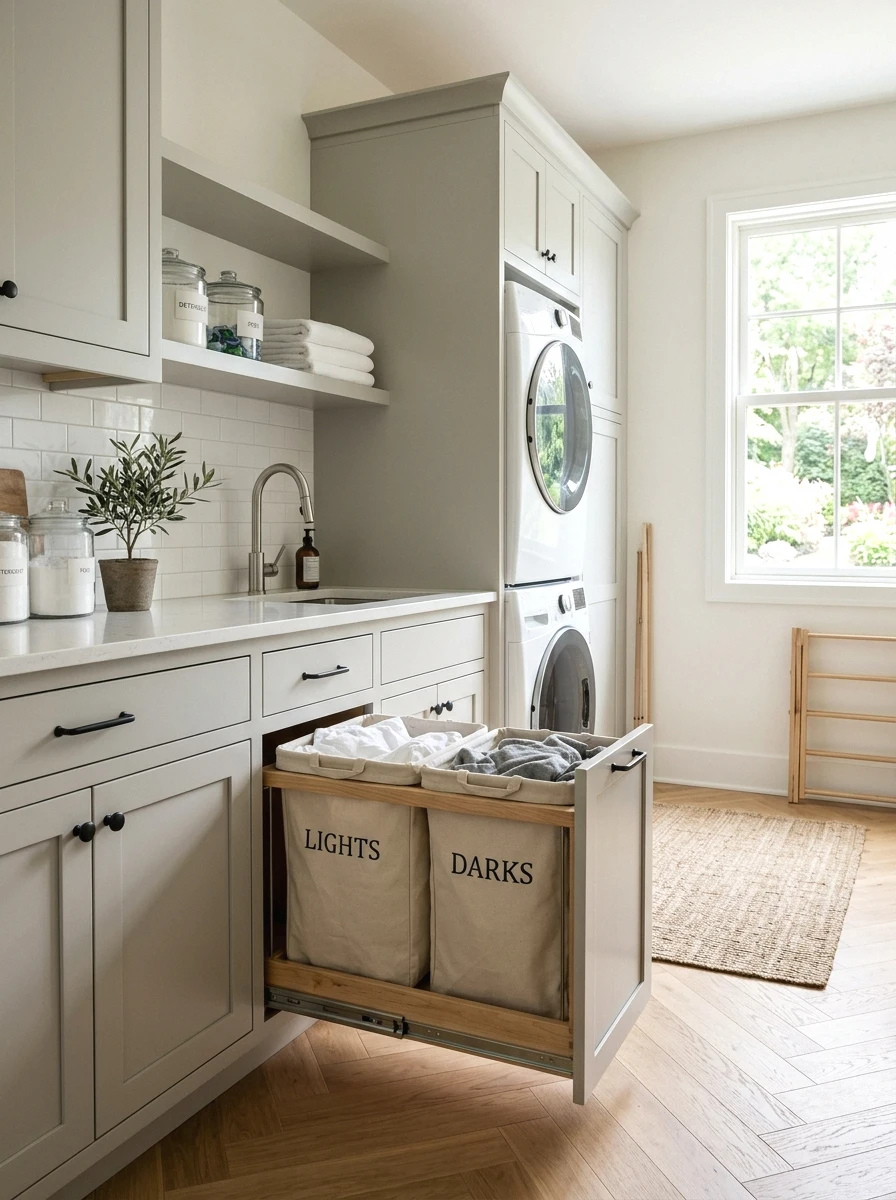
Pull-out hamper drawers built into cabinetry keep dirty laundry contained and out of sight while remaining fully accessible, and a dual-drawer setup lets you sort lights and darks directly at the point of collection.
Choose drawers with removable liner bags for easy transport to the washer, and confirm the drawer glides are rated for the weight of a full load of laundry, which is heavier than typical cabinet drawer contents.
Best suited for: full laundry room renovations and households wanting an integrated sorting and storage solution.
11. Task Lighting or Statement Pendant
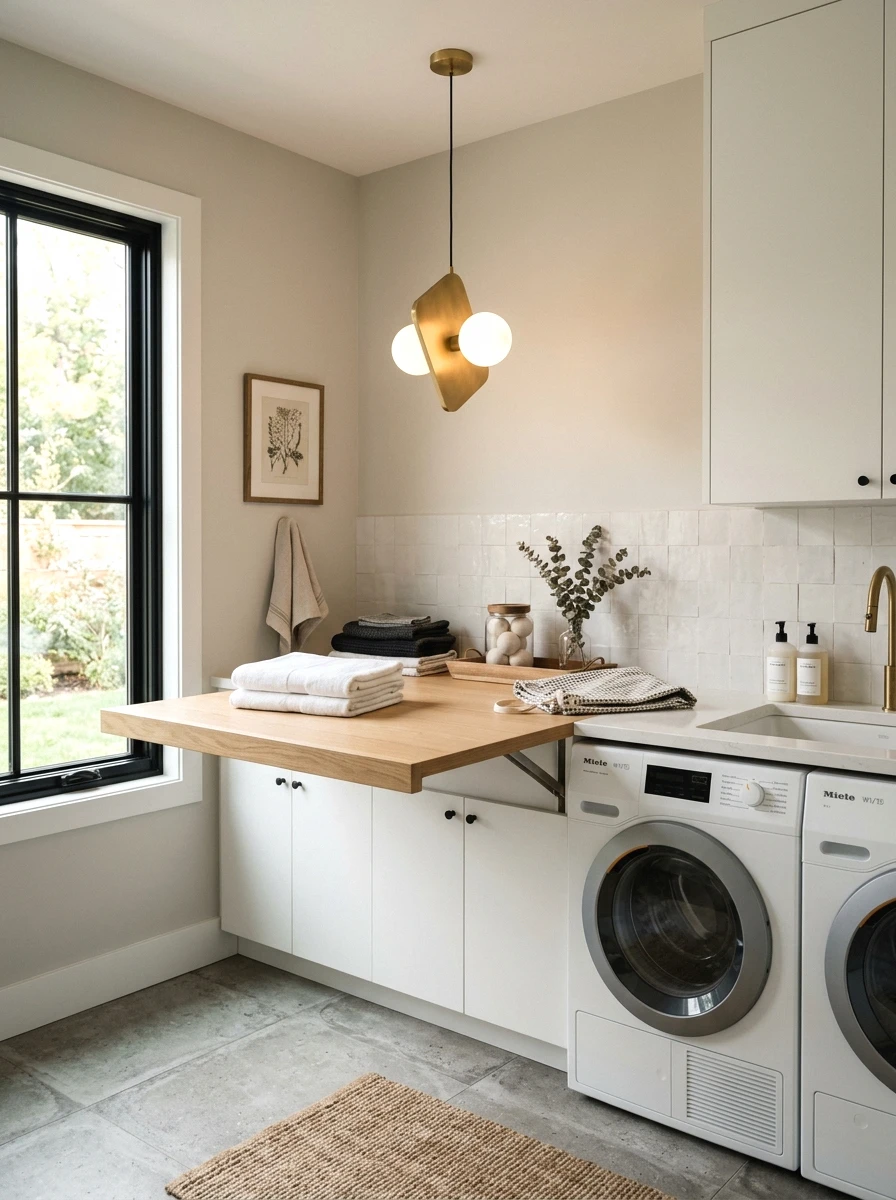
Proper task lighting over a folding counter or sink makes detail work like stain treatment and sorting significantly easier, and a statement pendant in particular gives the room a design moment beyond a standard overhead fixture.
Position the fixture directly above the primary work surface, like a folding counter or sink, rather than centered in the room, ensuring the light actually falls where detailed tasks happen.
Best suited for: any laundry room, and a relatively affordable upgrade with real functional benefit.
12. Fold-Down Built-In Ironing Board
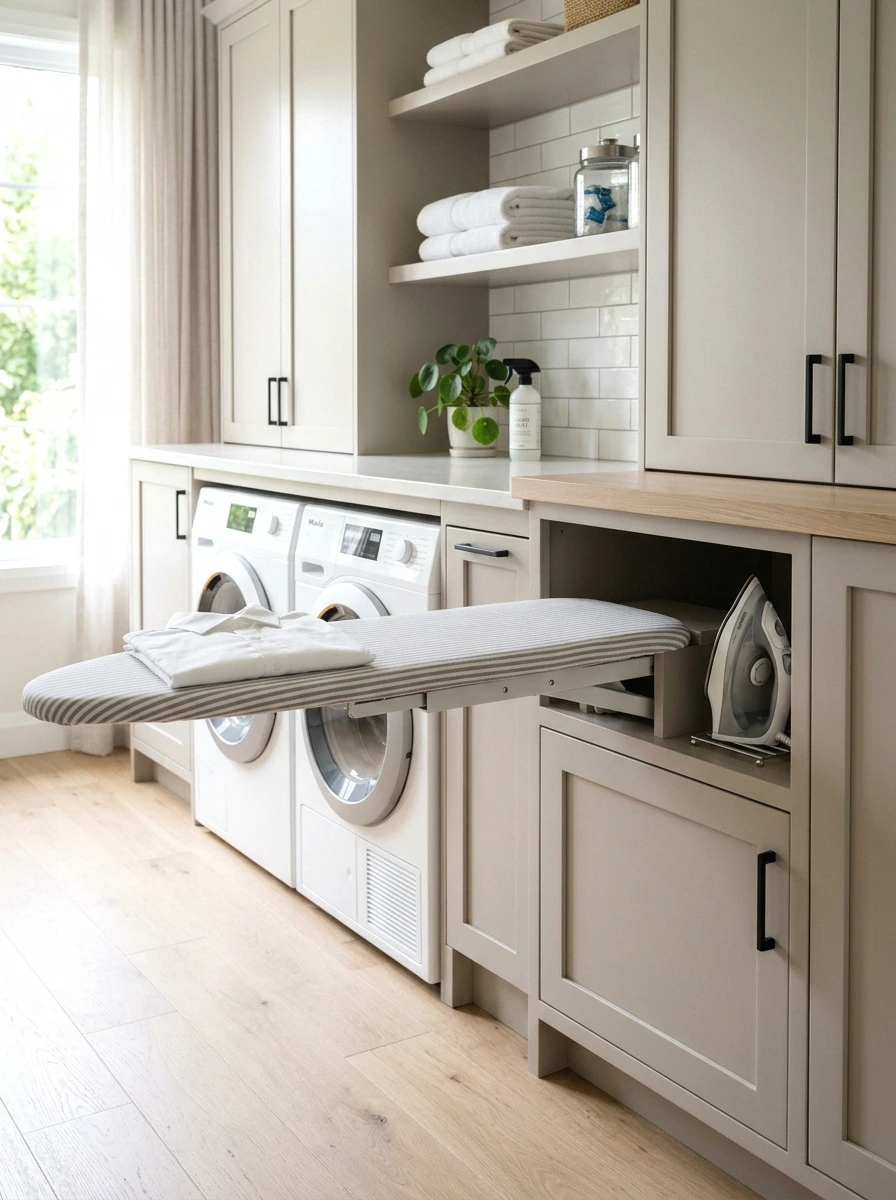
A built-in ironing board that folds flat into a cabinet when not in use eliminates the need to store and set up a bulky standalone ironing board, saving genuine floor space in a room where every square foot matters.
Position the built-in board near an outlet for the iron, and choose a model with a small storage compartment for the iron itself when folded away.
Best suited for: laundry rooms undergoing cabinetry installation and households that iron regularly.
13. Stacked Washer-Dryer for Small Spaces
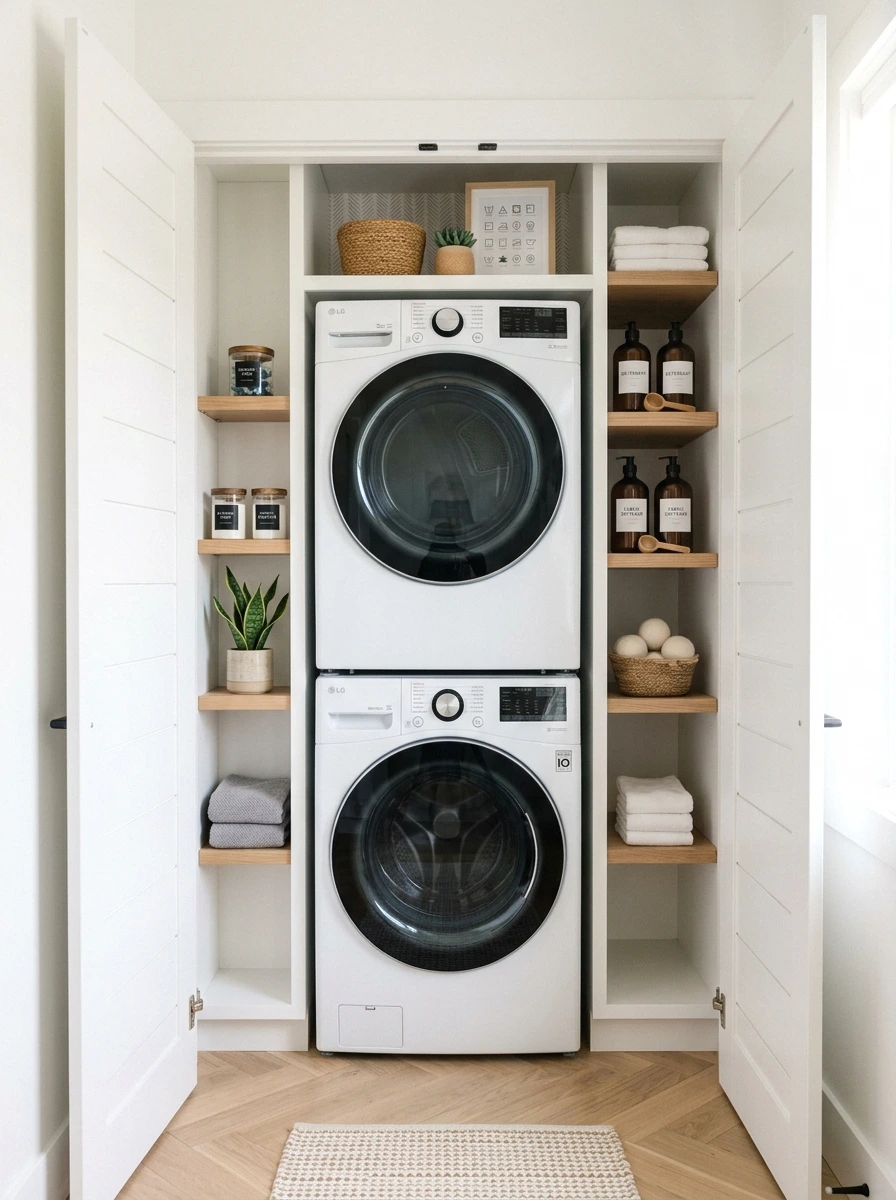
Stacking the washer and dryer vertically rather than placing them side by side frees up significant floor space in a small laundry closet, often enough to add a narrow shelving unit or small counter alongside the machines.
Confirm your specific washer and dryer models are stackable and rated for a stacking kit, since not all machines are designed for this configuration and require the correct hardware for safe installation.
Best suited for: small laundry closets and apartments where floor space is at a genuine premium.
14. Countertop Over Front-Load Machines
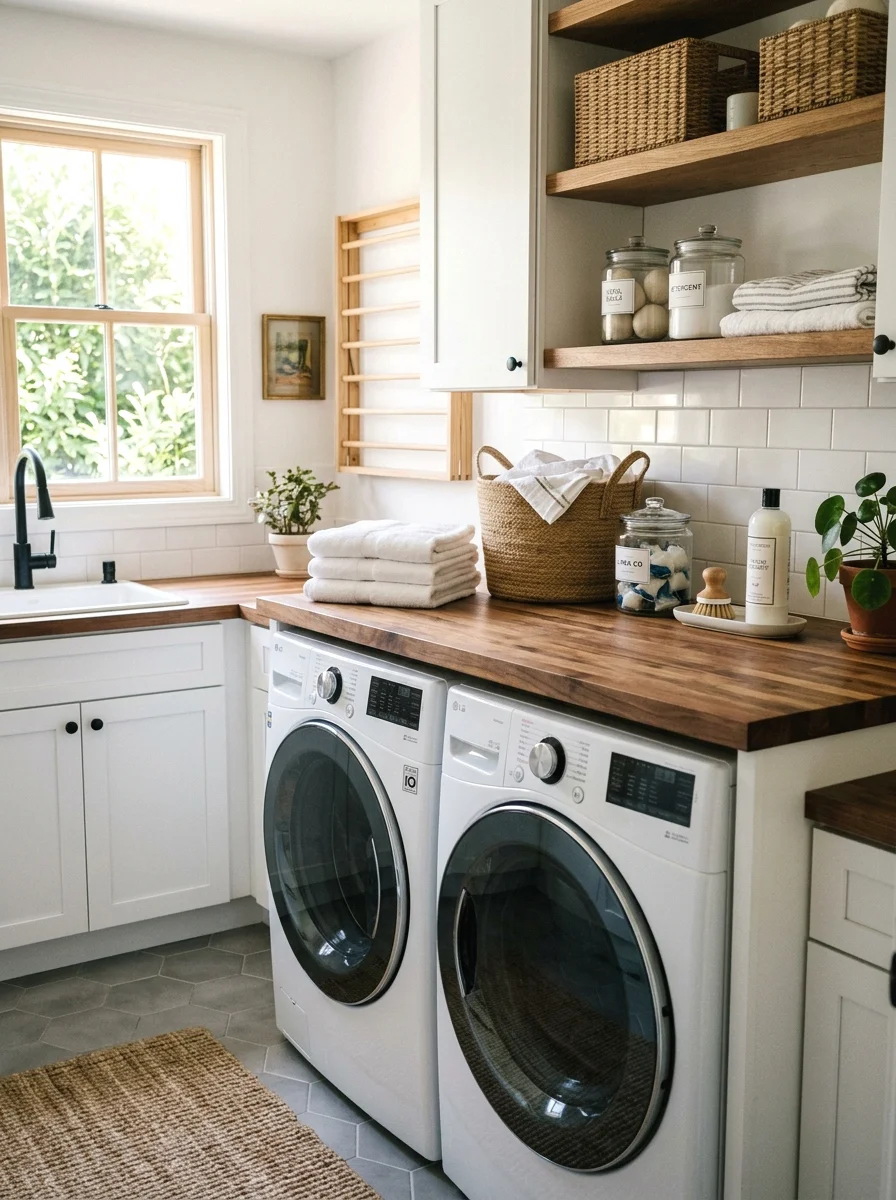
Installing a simple countertop directly over front-load machines creates instant folding surface space without requiring a full room renovation, making it one of the most cost-effective ways to solve the common lack of counter space in a laundry area.
Choose a countertop material like butcher block or laminate that can be custom-cut to fit snugly around your specific machines, and confirm the machines are front-load models, since top-load washers cannot accommodate this solution.
Best suited for: laundry rooms with front-load machines and no existing folding surface.
15. Labeled Glass or Ceramic Storage Jars
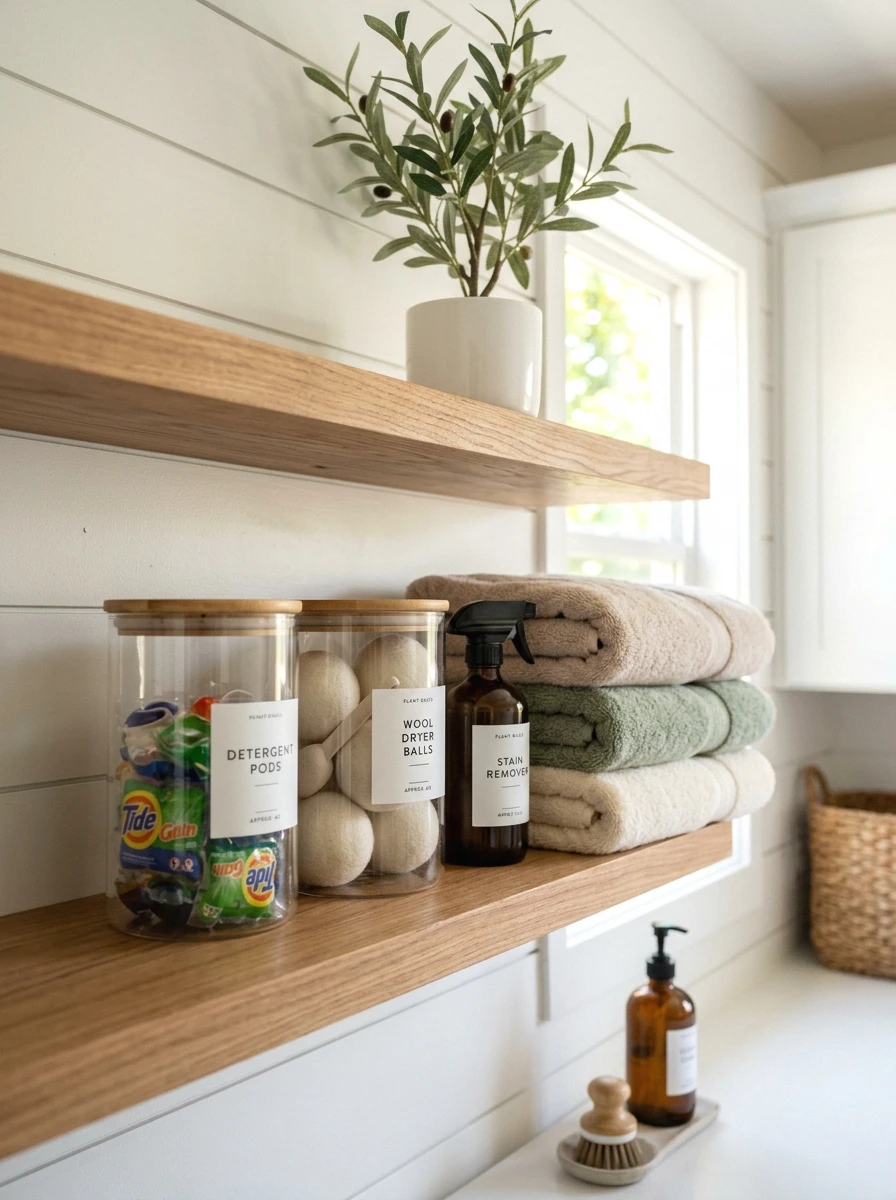
Decanting detergent pods, dryer balls, and other small supplies into labeled glass or ceramic jars elevates the room’s overall look significantly compared to leaving original plastic packaging out on open shelving.
Choose jars with airtight seals for items like detergent pods that can degrade with humidity exposure, and keep the label style consistent across all jars for a cohesive, intentional appearance.
Best suited for: laundry rooms with open shelving and homeowners wanting a more polished, styled look.
16. Pet Washing Station
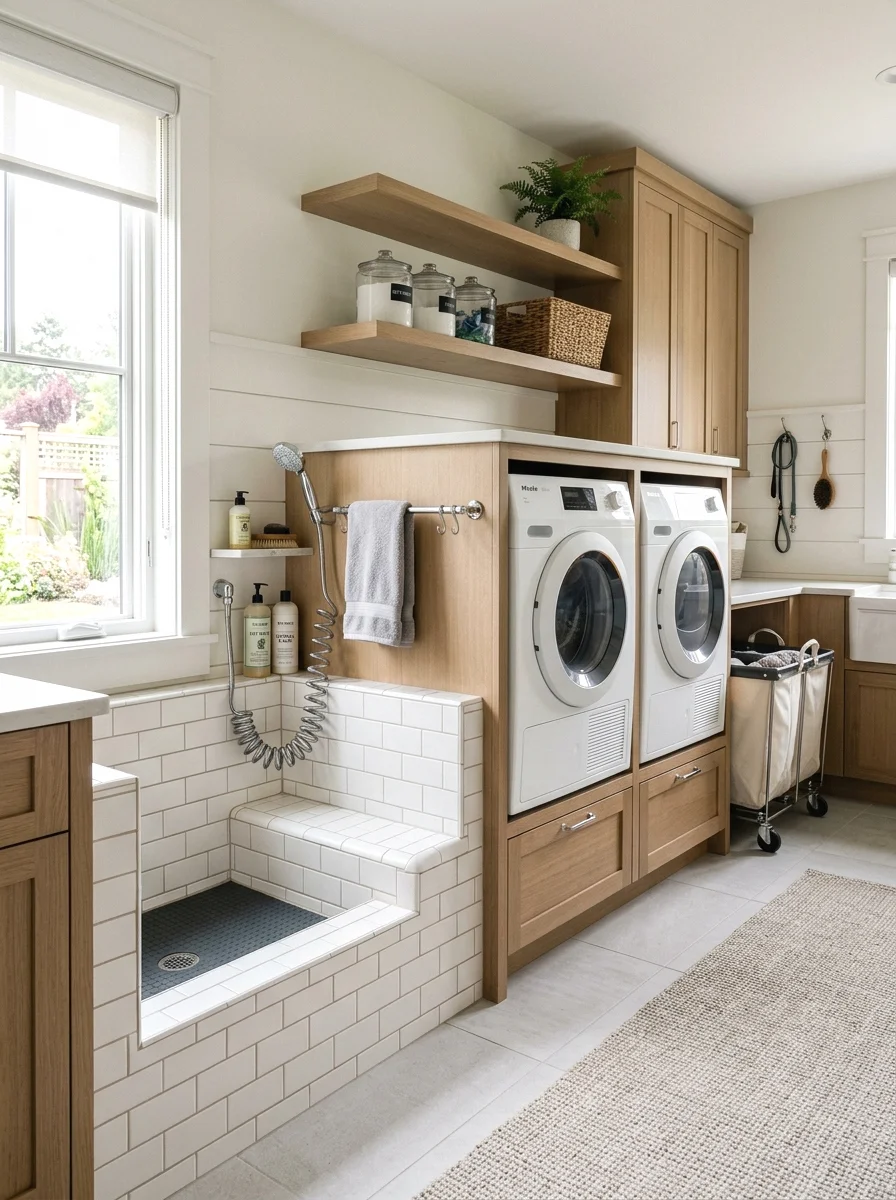
A dedicated pet washing station combined into the laundry room gives dog and cat owners a genuinely useful spot for regular baths, avoiding the strain of bathing pets in a bathtub or the mess of doing it outdoors.
Choose a raised basin height to reduce bending during pet baths, and include a handheld sprayer with adequate hose length to comfortably reach around the entire basin.
Best suited for: pet-owning households with laundry rooms that have adjacent plumbing access for a second water source.
17. Ventilated Indoor Drying Cabinet
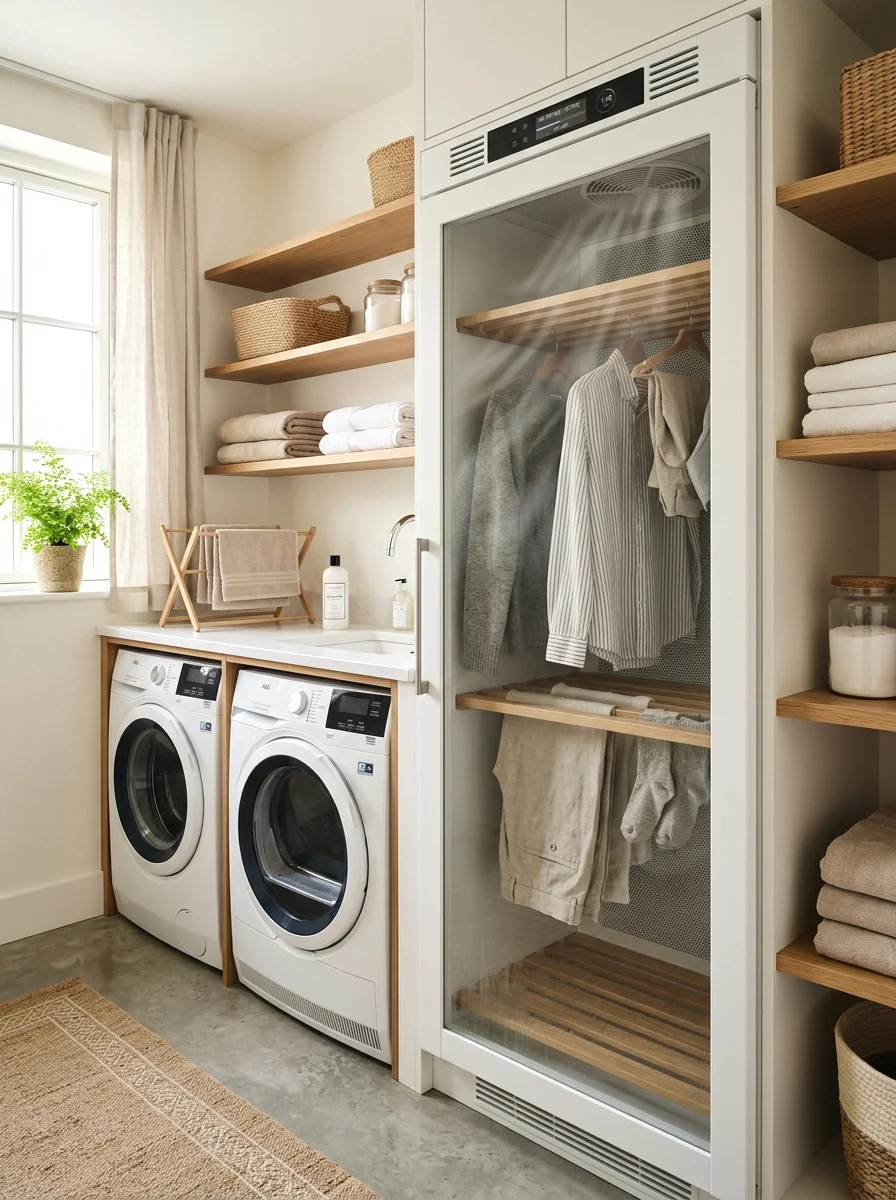
A dedicated drying cabinet with built-in ventilation gives delicate or specialty garments a proper enclosed space to air dry, protecting them from dust while ensuring adequate airflow to prevent mildew, which a simple open rack cannot fully address.
Confirm the cabinet has genuine ventilation, either through vented slats or a small fan system, since enclosed drying without airflow can trap moisture and create the exact mildew problem the cabinet is meant to prevent.
Best suited for: households with significant delicate or specialty garment care needs and full laundry room renovations.
Planning and Buying Tips
A few practical decisions up front will help your laundry room update function well for your household’s actual routine, not just look good when empty.
● Plan folding surface space based on your household’s laundry volume — a single small counter may not suffice for a larger family doing multiple loads weekly, so scale counter space to your actual usage.
● Standard sizing to shop for — a laundry counter typically needs a minimum depth of 24 inches to comfortably fold larger items like sheets, and standard stacked washer-dryer units require roughly 27 inches of width.
● Confirm ventilation and electrical requirements before any layout change — dryer venting in particular has specific code requirements that affect where a dryer can realistically be relocated within a room.
● Choose moisture-resistant materials for cabinetry and countertops — laundry rooms experience more humidity than most rooms in the house, so prioritize sealed, water-resistant finishes over materials prone to warping.
● Measure machine dimensions carefully before ordering custom cabinetry or countertops — washer and dryer models vary enough in size that a generic measurement can result in a poor fit for cabinetry built around them.
● Plan storage based on what actually needs to live in the room — detergent, dryer sheets, stain treatment, and hampers are common essentials, but avoid over-building storage capacity for items better kept elsewhere in the home.
Cost Breakdown: Budget, Mid-Range, and Luxury Updates
A laundry room update can range from a few affordable organizational upgrades to a full renovation with custom cabinetry and a utility sink.
Budget ($50–$600)
Floating shelves, storage bins, a hanging rod, and wallpaper fall in this range. Installation is largely DIY, with wallpaper application being the main labor consideration.
Mid-Range ($600–$4,000)
A countertop over front-load machines, open shelving with cabinetry, a statement light fixture, and new flooring sit in this tier. Professional installation for countertops or flooring typically adds $300–$1,200 depending on scope.
Luxury / Premium ($4,000–$15,000+)
A full renovation with custom built-in cabinetry, a farmhouse utility sink, pull-out hamper drawers, and a pet washing station falls here. Full professional installation, including plumbing and electrical work, typically runs $5,000 to $12,000 or more depending on the scope of cabinetry, plumbing, and finishes involved.
Layout and Feature Comparison
| Feature | Price Range | Space Efficiency | Installation Effort | Best For |
| Floating shelves | $30–$150 | High | Low | Small laundry rooms needing basic storage |
| Countertop over machines | $150–$800 | High | Moderate | Adding folding space without a full renovation |
| Built-in cabinetry with counter | $1,500–$6,000+ | High | High — professional install typical | Full renovations wanting maximum storage |
| Farmhouse utility sink | $300–$1,200 | Moderate | Moderate to high — plumbing required | Households needing heavy-duty hand-washing capability |
| Stacked washer-dryer | $0–$300 (stacking kit) | Very high | Low to moderate | Small closets and apartments |
| Pull-out hamper drawers | $200–$800 | Moderate | Moderate — cabinetry install | Integrated sorting and hidden laundry storage |
Maintenance Tips
● Countertops and cabinetry — wipe down regularly to prevent detergent residue buildup, and check sealant around any surface near the washer periodically for moisture damage.
● Utility sinks — clean the basin regularly to prevent staining from detergent and stain-treatment products, and check the drain periodically for lint buildup from hand-washed items.
● Open shelving and storage bins — reassess contents every few months, since laundry supplies can accumulate and overflow their designated storage if not periodically checked.
● Ventilation systems — clean dryer vents at least annually to maintain proper airflow and reduce fire risk, and check any drying cabinet ventilation for dust buildup that can reduce airflow efficiency over time.
● Wallpaper and painted surfaces — wipe down periodically to remove humidity-related dust buildup, and ensure adequate room ventilation to prevent moisture from affecting wall finishes over time.
● Common mistake to avoid — neglecting dryer vent cleaning, which is both a genuine fire safety issue and one of the most overlooked maintenance tasks in a laundry room despite being simple to address.
Frequently Asked Questions
How do I add counter space to a small laundry room?
Installing a custom-cut countertop directly over front-load washer and dryer units is one of the most space-efficient ways to add folding surface without a full renovation, since it uses existing machine footprint rather than requiring additional floor space.
What is the best flooring for a laundry room?
Porcelain tile and luxury vinyl are generally recommended for laundry room flooring, since both resist moisture well and hold up to the regular water exposure and foot traffic typical of this room.
How can I make a laundry room look nicer without a full renovation?
Open shelving with labeled storage, a statement light fixture, and bold wallpaper are among the most effective lower-cost ways to visually upgrade a laundry room without a structural renovation.
Do I need a utility sink in my laundry room?
A utility sink is not strictly necessary but is genuinely useful for hand-washing delicates, treating stains, and handling messier tasks like washing muddy boots or pet supplies, making it a worthwhile addition for households with these regular needs.
Can I stack my washer and dryer to save space?
Many front-load washer and dryer models can be stacked using a manufacturer-approved stacking kit, though it is important to confirm your specific models are rated for stacking before attempting this configuration.
How to Choose the Right Modern Laundry Room Ideas for You
The right combination of ideas depends on three factors: your available space, your household’s laundry volume, and your renovation budget. Small laundry closets benefit most from stacked machines, floating shelves, and a hanging rod, while larger dedicated rooms have space for full cabinetry, a utility sink, and additional features like a pet washing station.
Budget should guide sequencing rather than final scope — shelving, storage bins, and lighting offer meaningful improvement for a relatively low cost, while a full cabinetry and countertop renovation represents a bigger investment worth making once you understand exactly how the room needs to function.
Finally, think about your household’s specific laundry habits. Frequent hand-washing or pet ownership points toward a utility sink or washing station, while a household doing high laundry volume benefits most from maximizing folding counter space and hamper storage.
Start with the storage and counter space upgrades that address your household’s biggest daily laundry frustration, then layer in style details like lighting and wallpaper from there — a truly functional modern laundry room comes from solving real daily problems first, with the design details building on top of that foundation.


- Be Respectful
- Stay Relevant
- Stay Positive
- True Feedback
- Encourage Discussion
- Avoid Spamming
- No Fake News
- Don't Copy-Paste
- No Personal Attacks
- Be Respectful
- Stay Relevant
- Stay Positive
- True Feedback
- Encourage Discussion
- Avoid Spamming
- No Fake News
- Don't Copy-Paste
- No Personal Attacks
