20 Mid-Century Modern Living Room Ideas That Never Go Out of Style
Published: 7 Sep 2026
Mid-century modern design has stayed popular for decades for a simple reason: clean lines, warm wood tones, and organic shapes age well in a way that trend-driven styles often do not. Mid-century modern living room ideas work well for anyone who wants a room that feels curated and timeless rather than matched to a passing trend cycle, and the style is flexible enough to work in a starter apartment or a full home renovation. It also tends to photograph beautifully, which makes it a favorite for anyone building out a Pinterest board or planning a room they will not want to redo in five years. This guide covers 20 mid-century modern living room ideas for every space and budget, from statement furniture pieces to lighting, color, and layout details. Along the way, you will find honest pros and cons, real price ranges, a furniture and material comparison table, maintenance advice, and answers to the questions people search for most before committing to the style. By the end, you will know exactly which elements to prioritize for your room, your budget, and your existing furniture.
Is Mid-Century Modern Right for You?
Mid-century modern is one of the more forgiving design styles to commit to, but it is worth weighing the trade-offs honestly before redesigning a full room around it.
Pros
● Long-term style relevance — mid-century modern has remained popular for over 70 years, which makes it a safer long-term investment than more trend-driven aesthetics.
● Strong resale value on furniture — authentic and well-made mid-century pieces often hold or increase in value, unlike most mass-market furniture styles.
● Works in small and large spaces alike — the style’s low-profile furniture and clean lines make it especially well-suited to smaller apartments, while still scaling up in larger homes.
● Mixes well with other styles — mid-century pieces layer easily into transitional, Scandinavian, or eclectic rooms, so you do not need to commit to the style in every detail.
Cons
● Authentic vintage pieces can be expensive — original mid-century furniture from known designers often carries a high price tag, especially for signed or documented pieces.
● Reproduction quality varies widely — budget reproductions can look close in photos but differ significantly in materials and construction compared to authentic or high-quality remake pieces.
● Bold accent colors are not for everyone — classic mid-century palettes lean into mustard, teal, and burnt orange, which some homeowners find harder to commit to than neutral tones.
● Sourcing takes time — building a genuinely well-curated mid-century room, especially with vintage finds, often takes longer than furnishing a room from a single retailer.
For most homeowners, mid-century modern is a worthwhile long-term investment, especially if you mix a few well-made key pieces, like a credenza or lounge chair, with more affordable reproductions or complementary items rather than trying to source everything as an authentic vintage find.
1. Warm Walnut Wood Tones With Tapered Legs
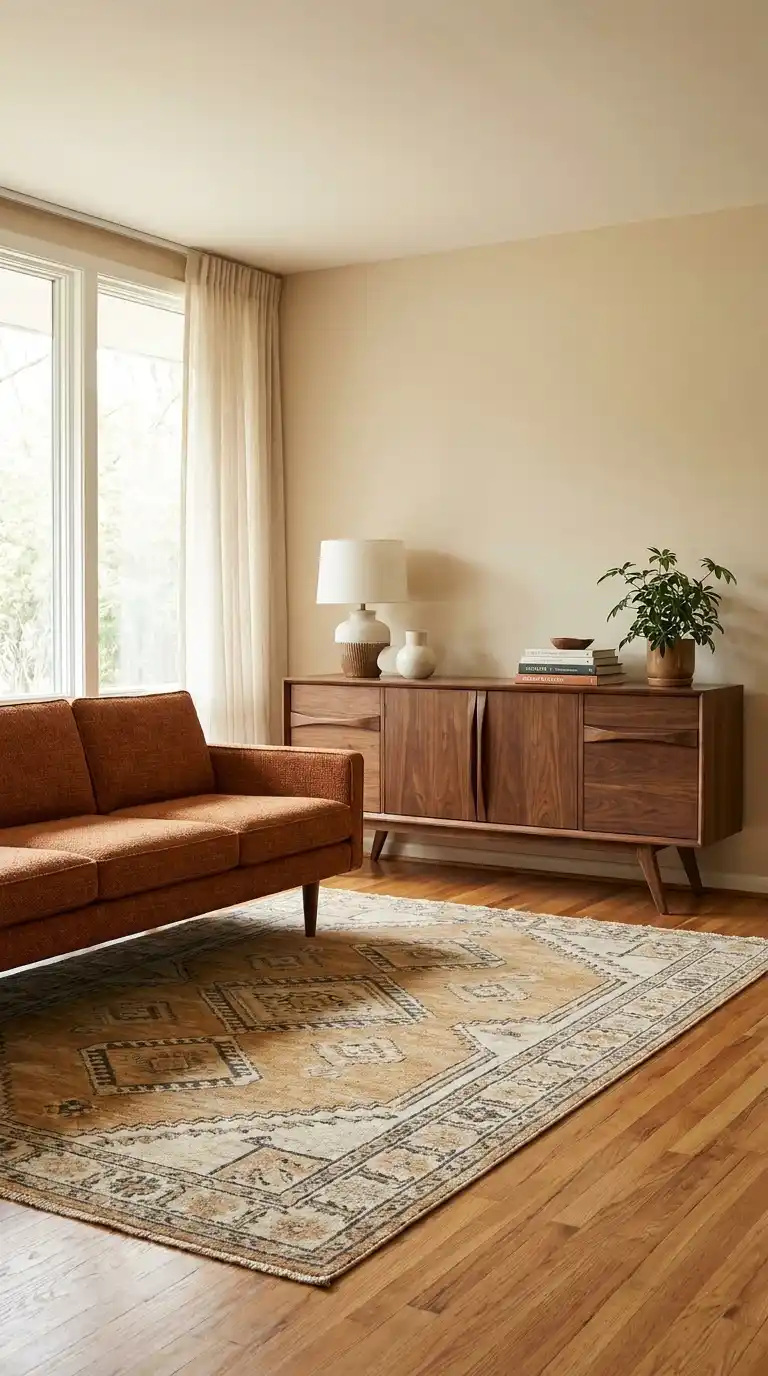
Warm walnut tones and visibly tapered furniture legs are two of the most defining features of mid-century modern design, and together they create the style’s signature warm-but-clean visual language.
Choose furniture where the wood tone is consistent across major pieces, like the sofa legs, coffee table, and credenza, so the room reads as cohesive rather than assembled from mismatched wood finishes.
Best suited for: living rooms starting a mid-century transformation from scratch, since wood tone consistency is the foundation the rest of the style builds on.
2. Sunburst Mirror or Wall Clock
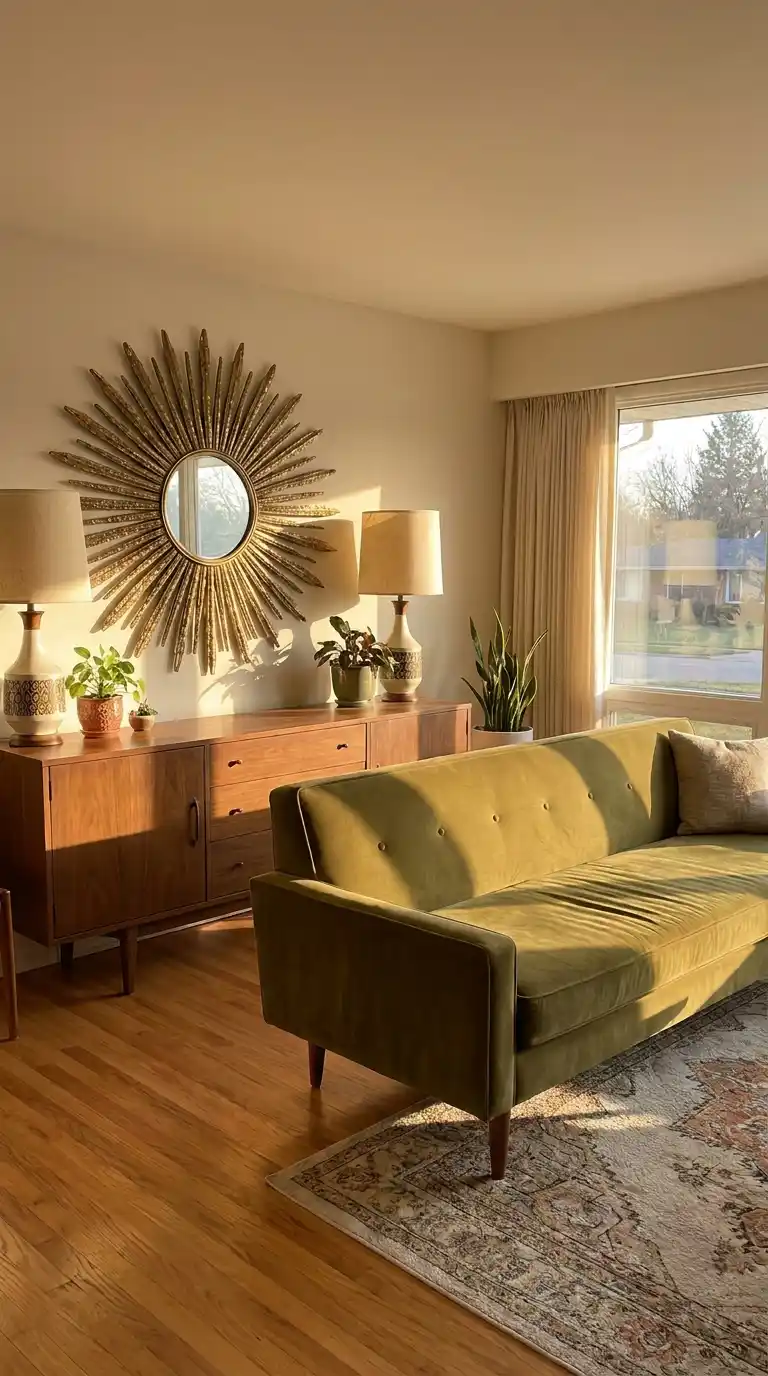
A sunburst mirror or wall clock is one of the most recognizable mid-century decor accents, and its radiating shape adds visual energy to a wall without requiring bold color or busy pattern.
Hang it above a credenza or sofa at a height where the full radiating shape is visible without touching the ceiling or crowding nearby art, since the piece needs breathing room to read clearly.
Best suited for: living rooms wanting a quick, high-impact mid-century accent without committing to new furniture.
3. Iconic Shell or Egg-Style Accent Chair
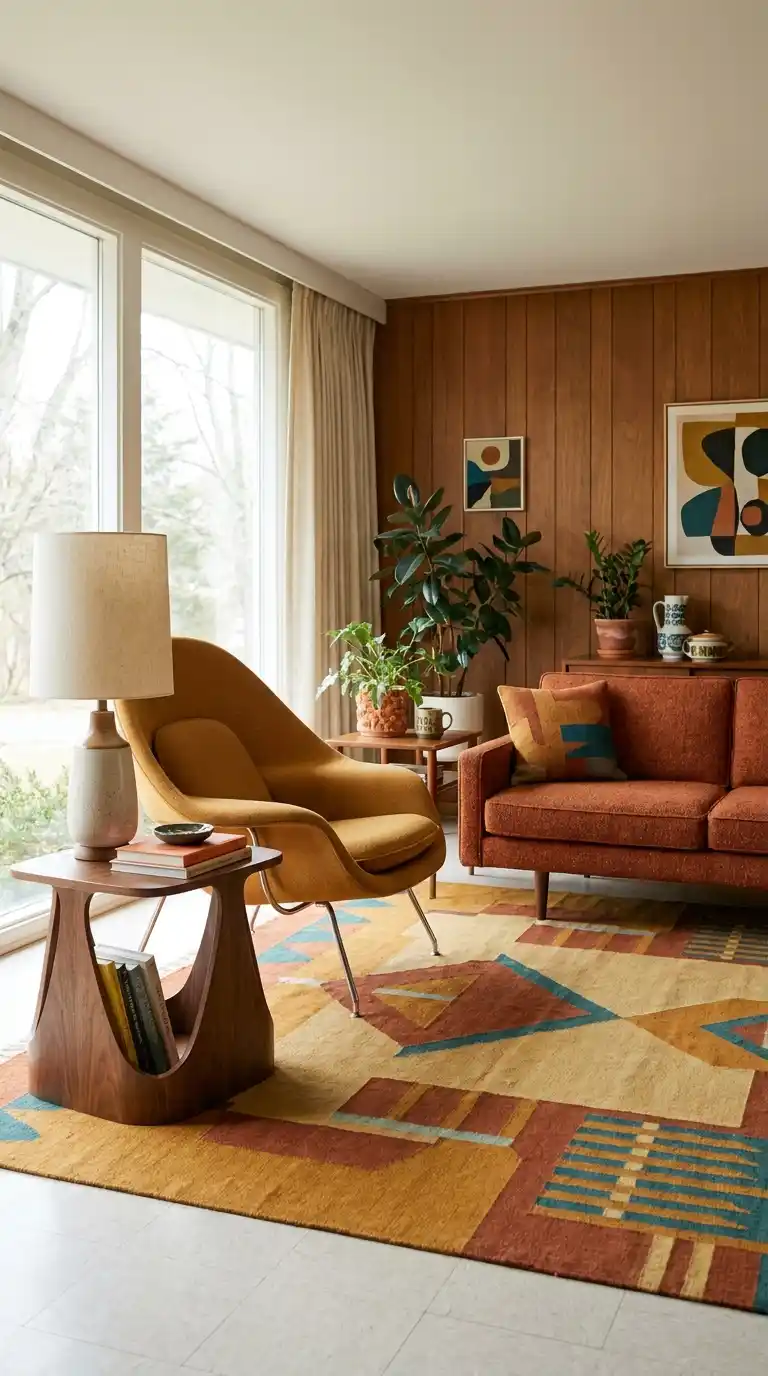
A single molded shell or egg-style chair adds an unmistakable mid-century silhouette to a room, and its sculptural shape works well as a secondary seat that draws attention without overwhelming the main sofa.
Choose a bold accent color like mustard, teal, or burnt orange for the chair upholstery if the rest of the room stays neutral, letting the chair function as the room’s clear color statement.
Best suited for: living rooms wanting one strong design statement piece rather than a full furniture overhaul.
4. Low-Profile Sectional or Sofa
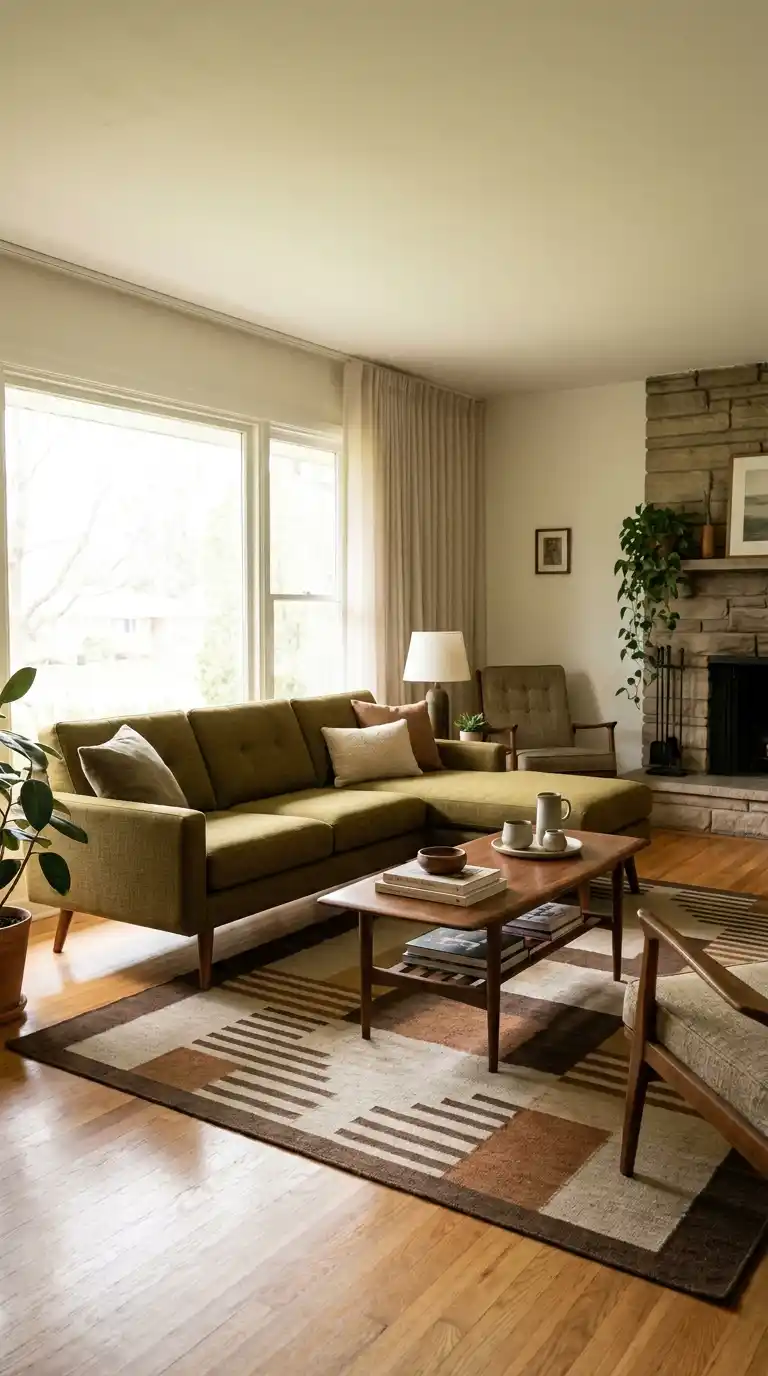
Mid-century sofas sit noticeably lower to the ground than most contemporary furniture, which creates the style’s signature horizontal, grounded silhouette and tends to make ceilings feel taller by comparison.
Look specifically for exposed, tapered wood legs rather than a fully upholstered base, since visible legs are one of the clearest visual markers separating mid-century sofas from more generic modern styles.
Best suited for: living rooms undergoing a full furniture update and anyone wanting the style’s signature silhouette as the room’s foundation.
5. Bold Geometric Area Rug
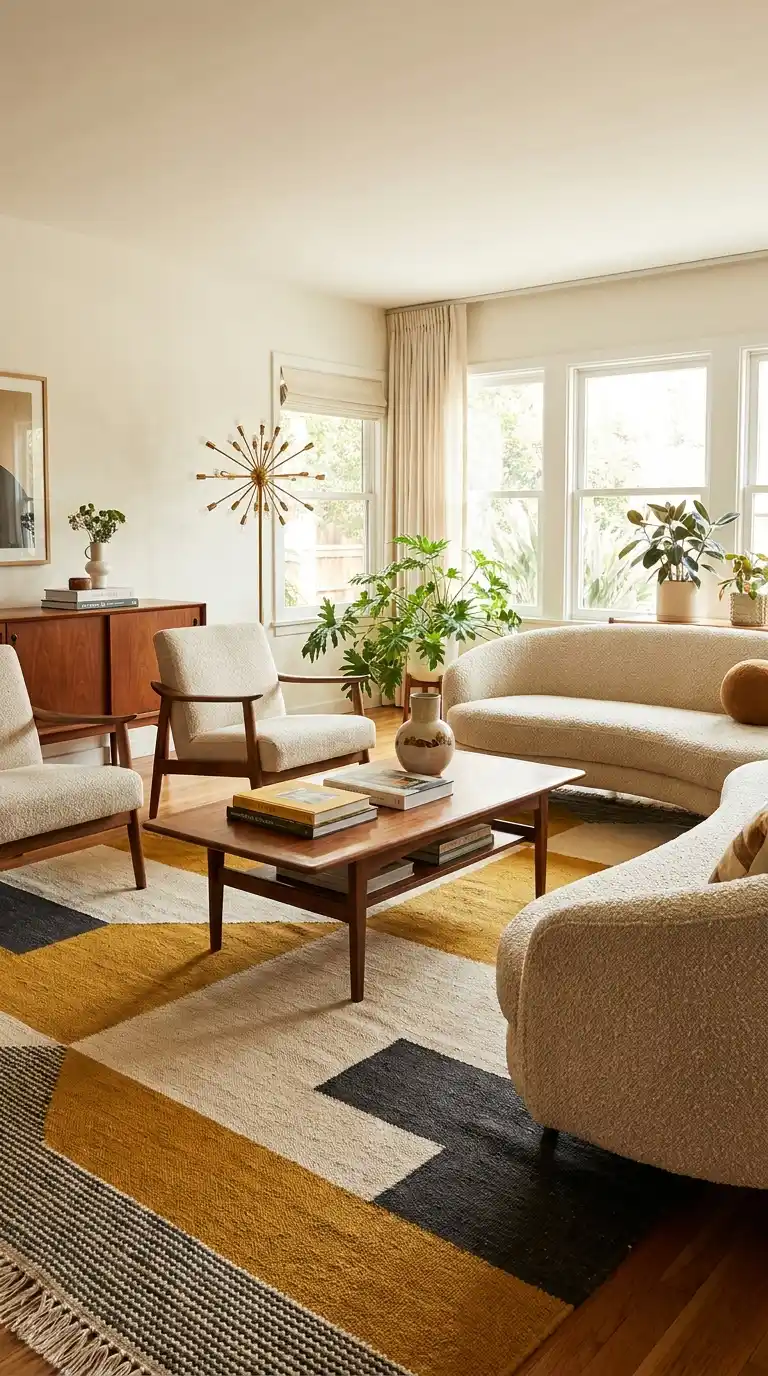
A bold geometric rug grounds a mid-century seating area and introduces the style’s characteristic graphic patterns, which tend to feature repeating shapes, arcs, or angular forms rather than florals or damask.
Size the rug so that all major furniture pieces, at minimum, the front legs of the sofa and chairs, sit on the rug, which keeps the seating area feeling intentional and connected.
Best suited for: living rooms wanting pattern and color underfoot while keeping walls and furniture more neutral.
6. Statement Arc or Tripod Floor Lamp
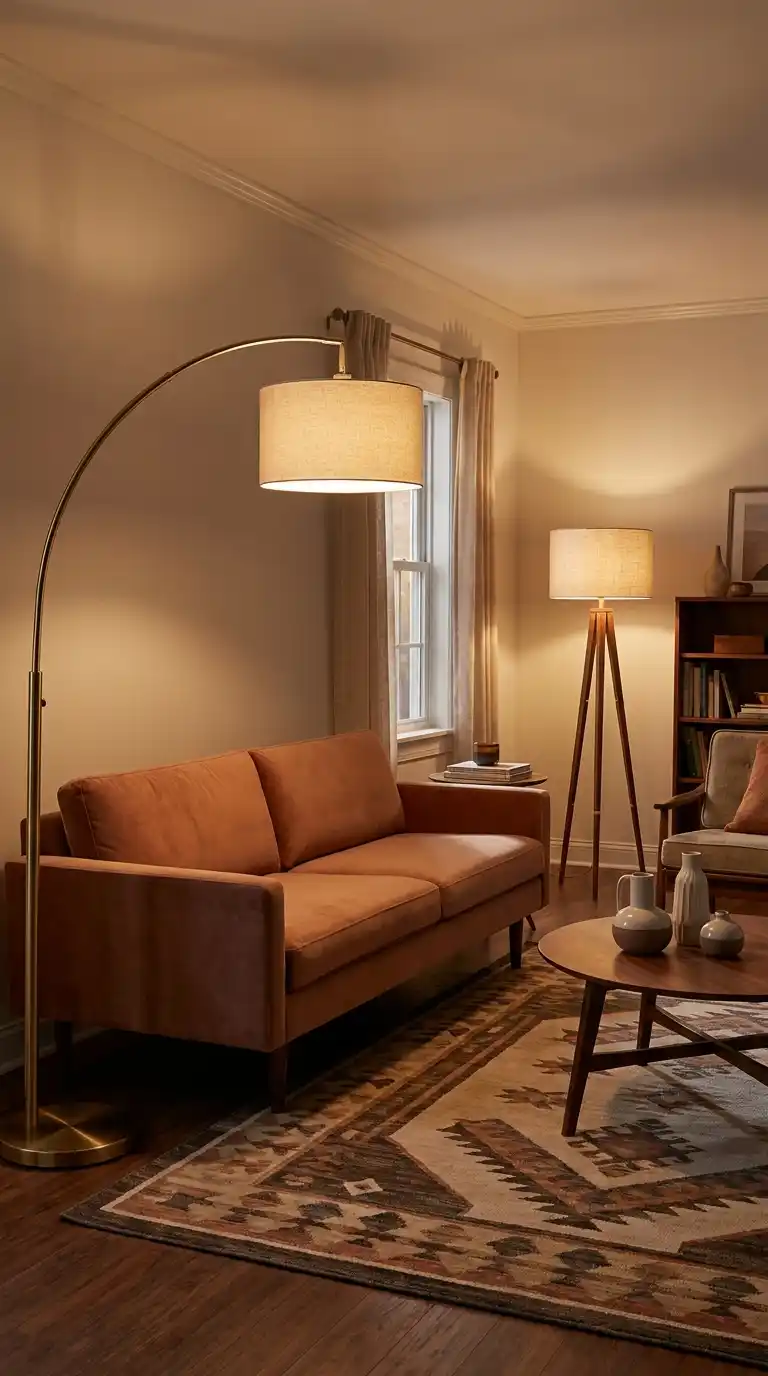
An arc floor lamp or a tripod-legged floor lamp adds sculptural lighting that doubles as a design statement, and both silhouettes are strongly associated with the mid-century era.
Position an arc lamp so its arm extends over a seating area like a sofa or reading chair, providing functional overhead light without requiring a hardwired ceiling fixture.
Best suited for: living rooms needing additional ambient or task lighting alongside a strong style statement.
7. Walnut Credenza or Built-In Storage
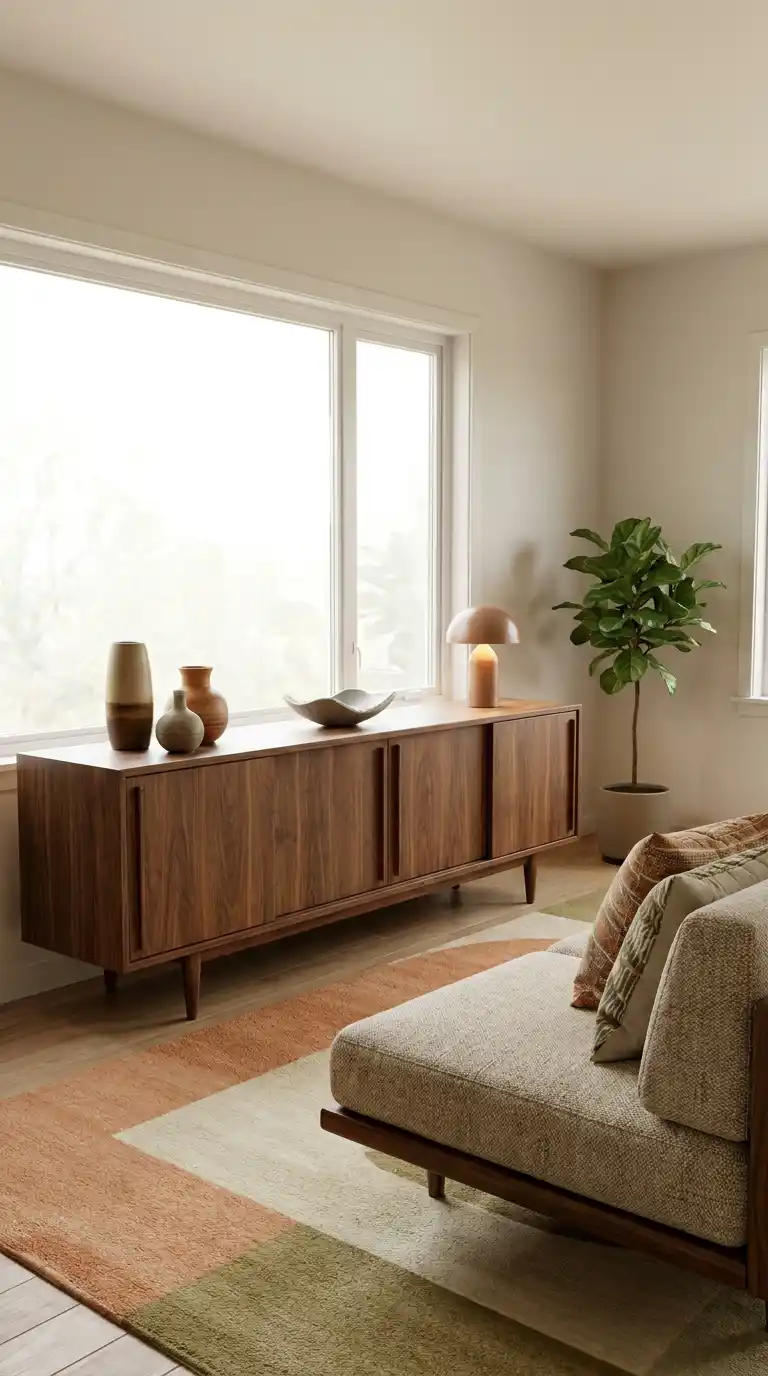
A long, low walnut credenza is one of the most functional mid-century pieces available, offering storage for media equipment, books, or games while doubling as a display surface for decor.
Style the top of the credenza with a small, curated collection of objects, like a lamp, a ceramic vase, and one or two books, rather than filling the entire surface, since restraint is part of the style’s visual language.
Best suited for: living rooms needing storage for media equipment or general clutter, and anyone wanting a functional focal piece.
8. Bold Accent Wall Color
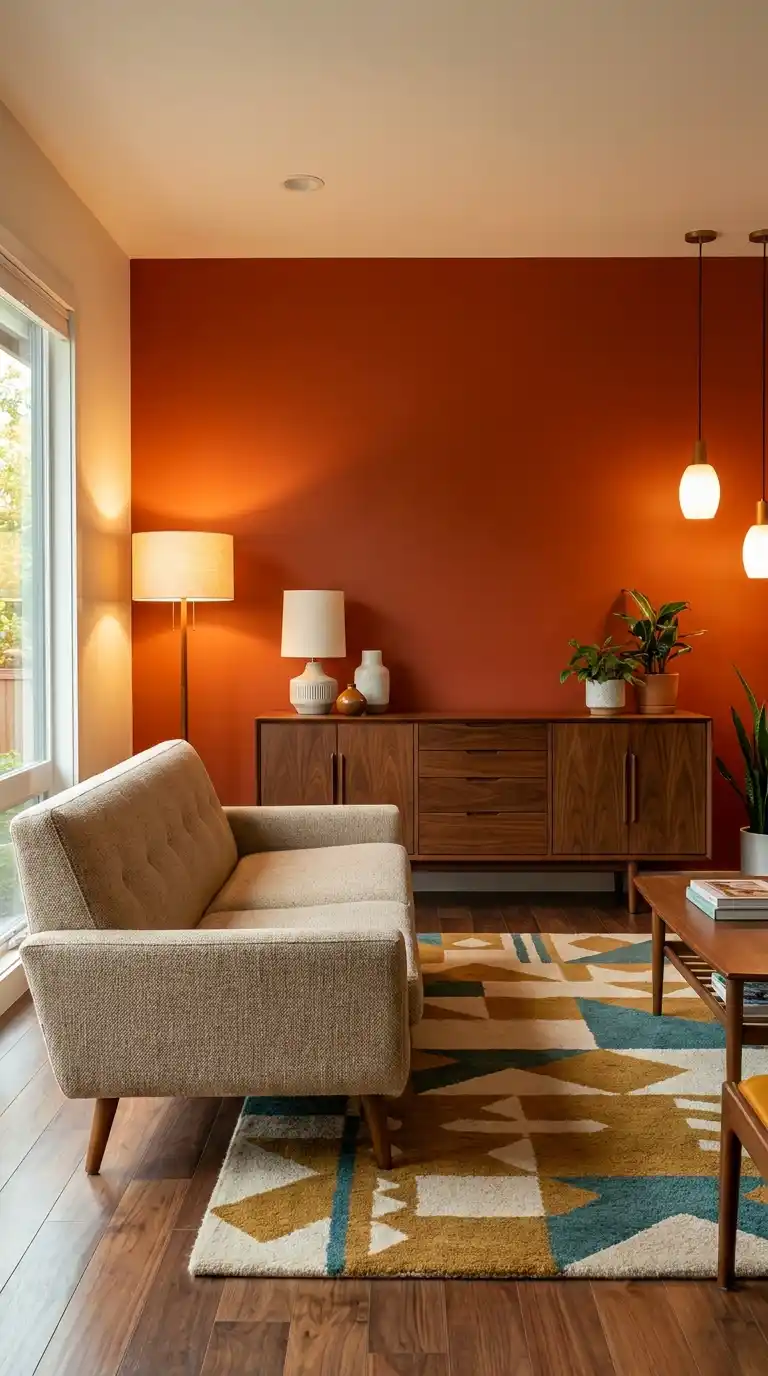
Classic mid-century color palettes lean into warm, saturated tones like mustard, burnt orange, olive, and teal, and a single accent wall in one of these colors instantly signals the era without requiring a full room repaint.
Pair a bold accent wall with warm wood furniture rather than cooler-toned pieces, since the combination of warm wood and warm saturated color is central to the style’s overall look.
Best suited for: living rooms wanting a bold color statement without committing to it across every wall.
9. Vertical Wood Slat Paneling
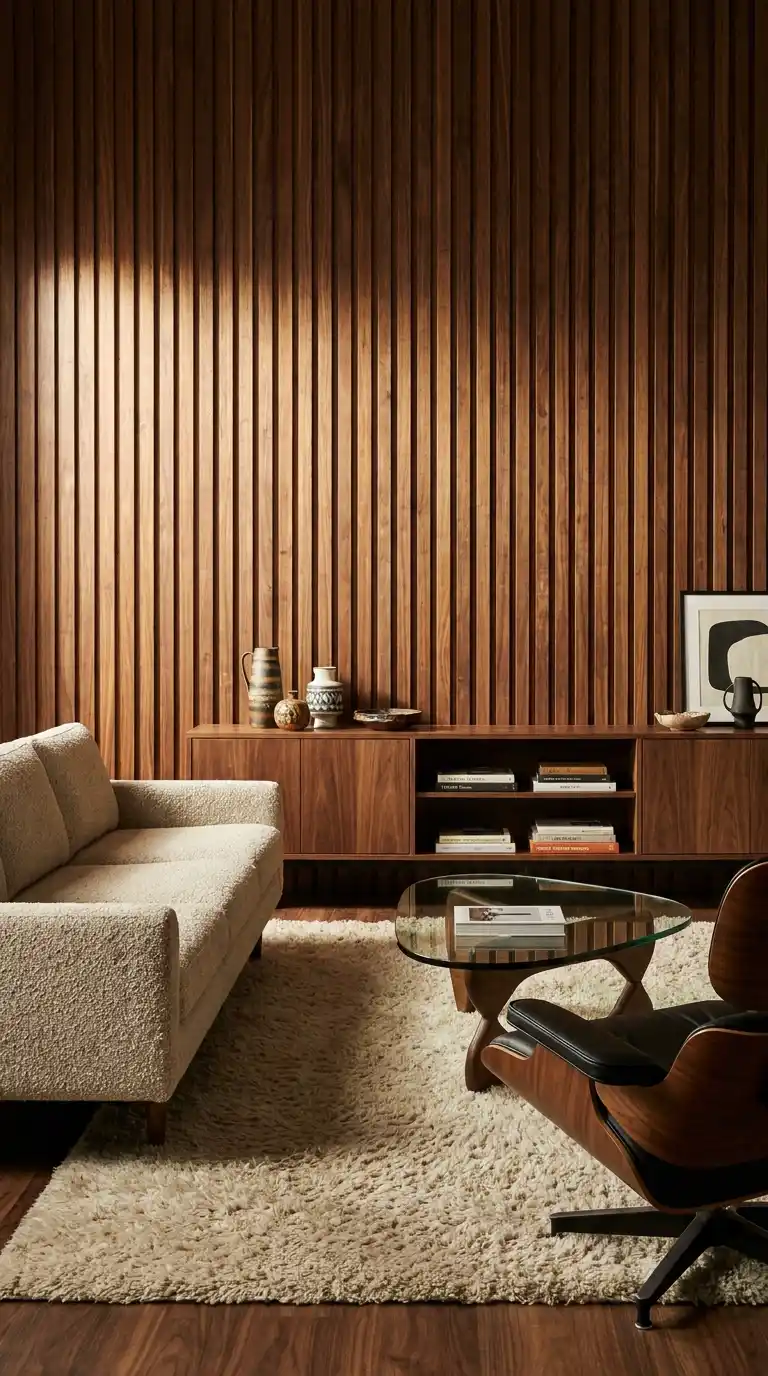
Vertical wood slat paneling brings genuine architectural texture to a wall and pairs naturally with mid-century furniture, since both share the era’s emphasis on visible, warm wood grain.
Use slat paneling behind a media console or sofa as a backdrop rather than covering an entire room, letting the texture serve as a focal wall rather than a repeated pattern throughout.
Best suited for: living rooms wanting a more substantial architectural update alongside furniture and decor changes.
10. Vintage-Inspired Bar Cart
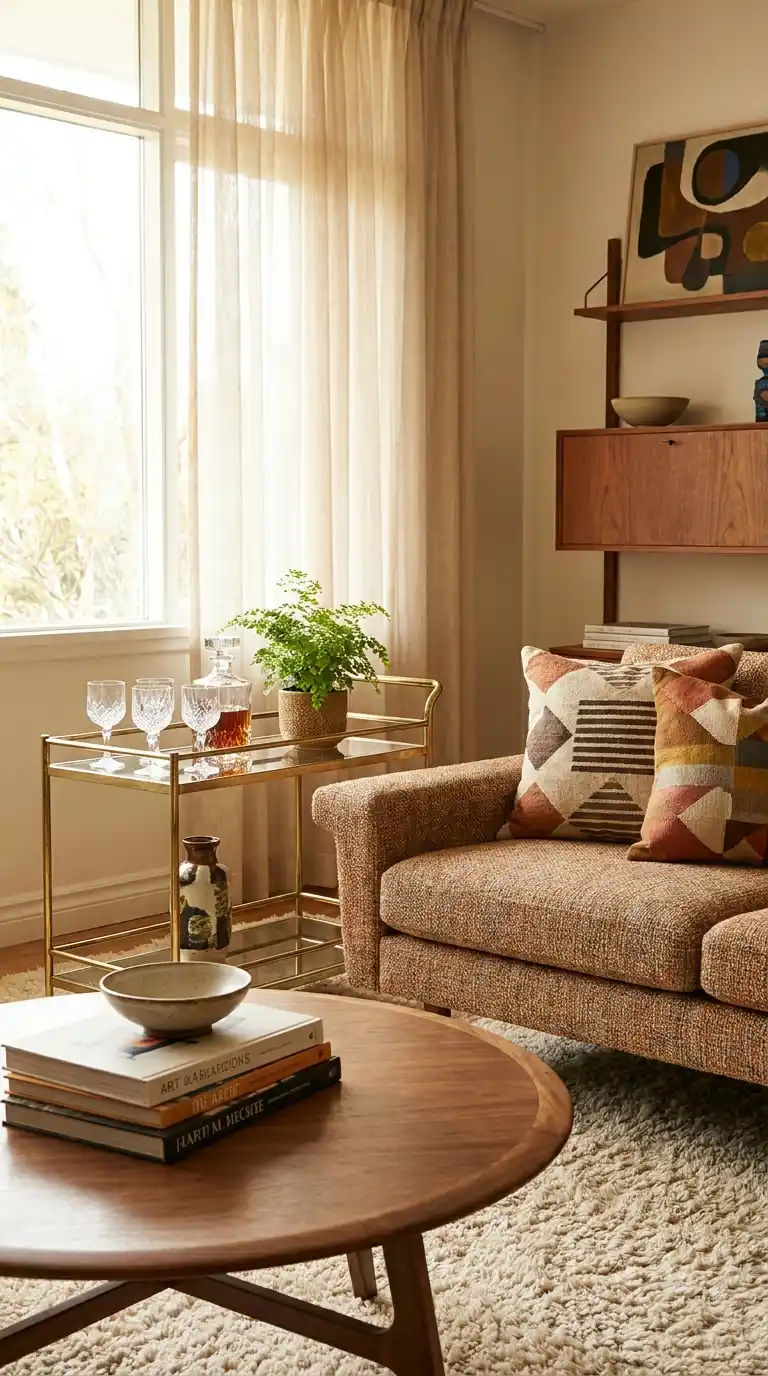
A bar cart on slim brass or wood legs adds both function and a strong mid-century silhouette to a living room, and it tends to double as a natural gathering point when entertaining.
Style the cart with a curated, limited selection of glassware and one or two bottles rather than filling every shelf, keeping the look intentional rather than cluttered.
Best suited for: living rooms that regularly host guests and anyone wanting a compact, functional accent piece.
11. Organic-Shaped Coffee Table
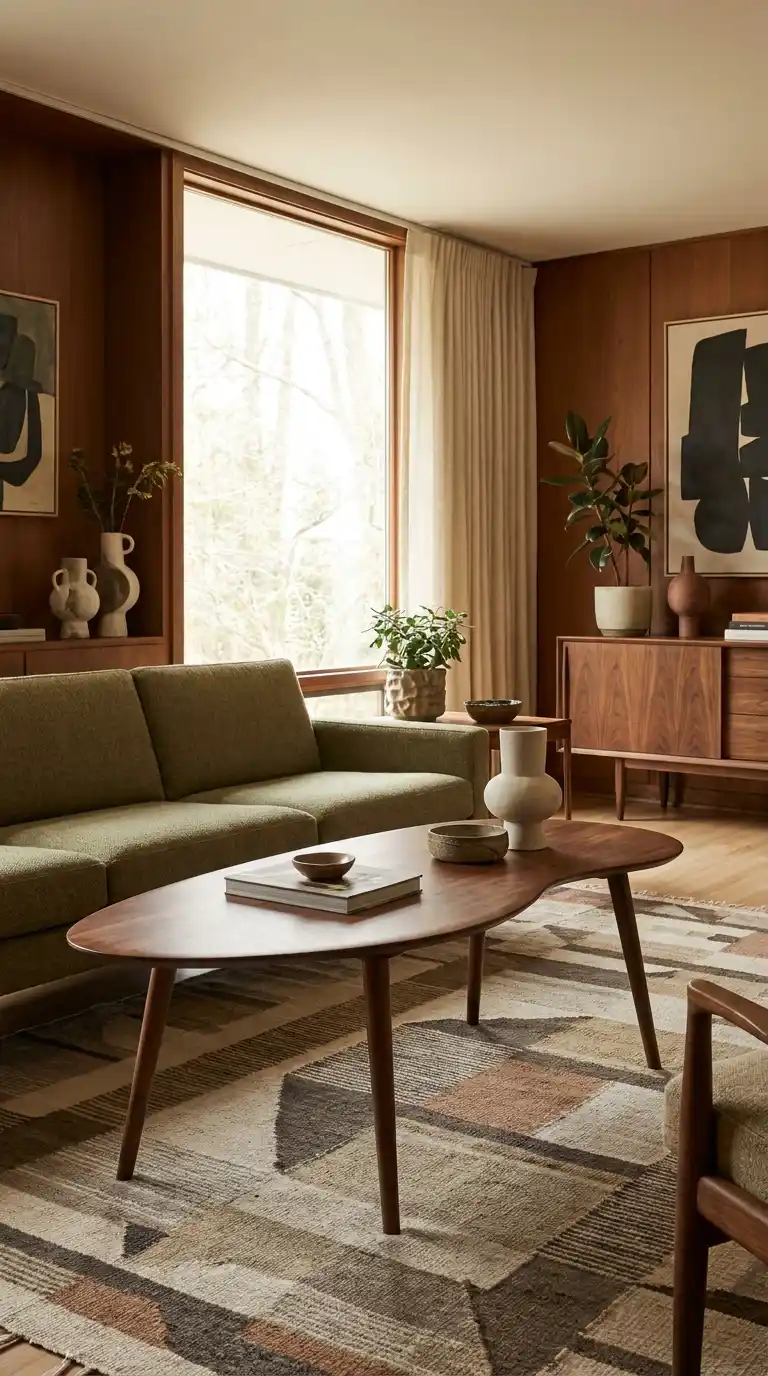
An organic, kidney- or boomerang-shaped coffee table softens the otherwise clean, geometric lines common throughout mid-century furniture, and its sculptural form works well as a standalone design statement.
Choose a table sized proportionally to your sofa, generally about two-thirds of the sofa’s length, so the organic shape has room to be appreciated without feeling cramped in the seating area.
Best suited for: living rooms wanting a softer complement to otherwise angular mid-century furniture.
12. Retro-Patterned Throw Pillows and Textiles
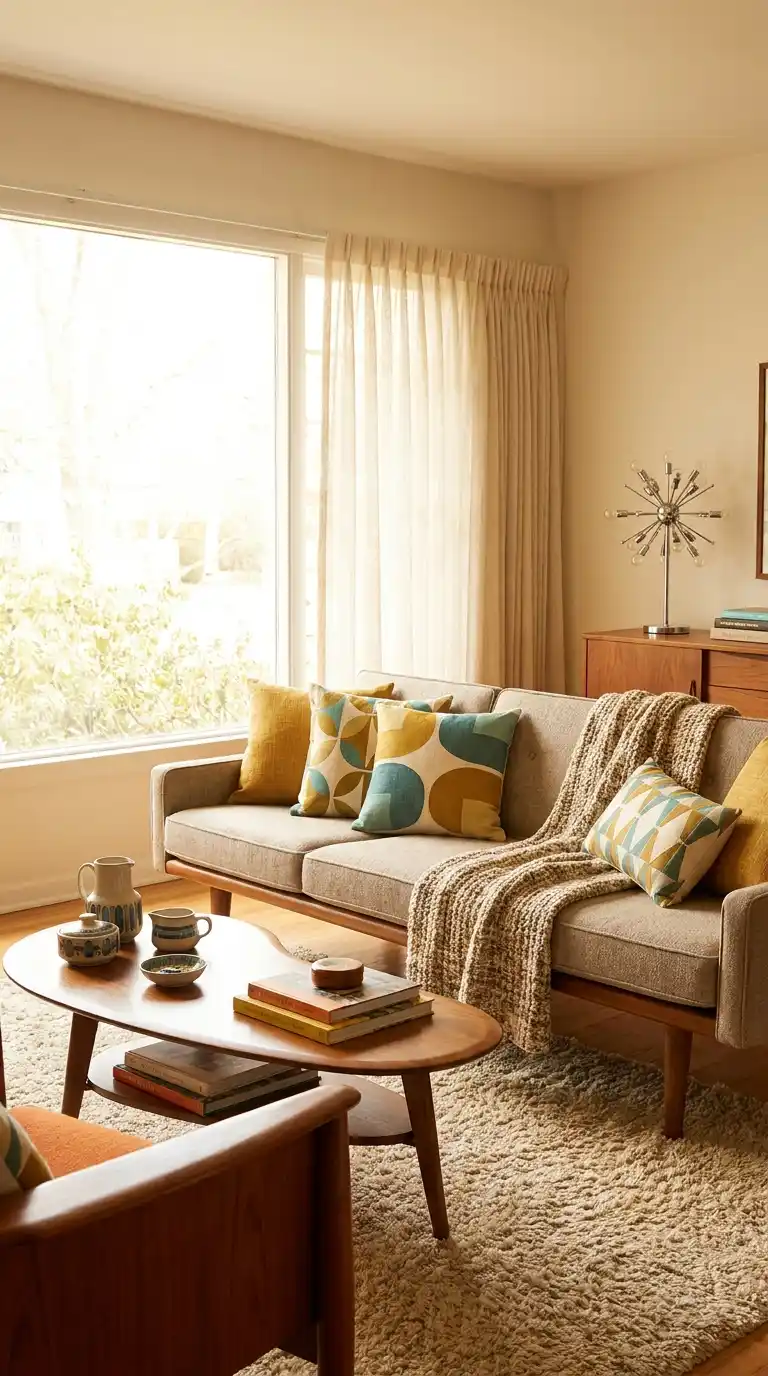
Retro-patterned throw pillows and textiles are one of the lowest-cost ways to bring mid-century color and pattern into a room, and they can be swapped out easily if you want to update the palette later.
Mix two or three coordinating patterns rather than a single repeated print, choosing pillows in varying scales, such as one bold geometric and one smaller textured solid, for visual balance.
Best suited for: renters and anyone wanting to test mid-century color and pattern before committing to larger furniture purchases.
13. Large-Scale Abstract Art
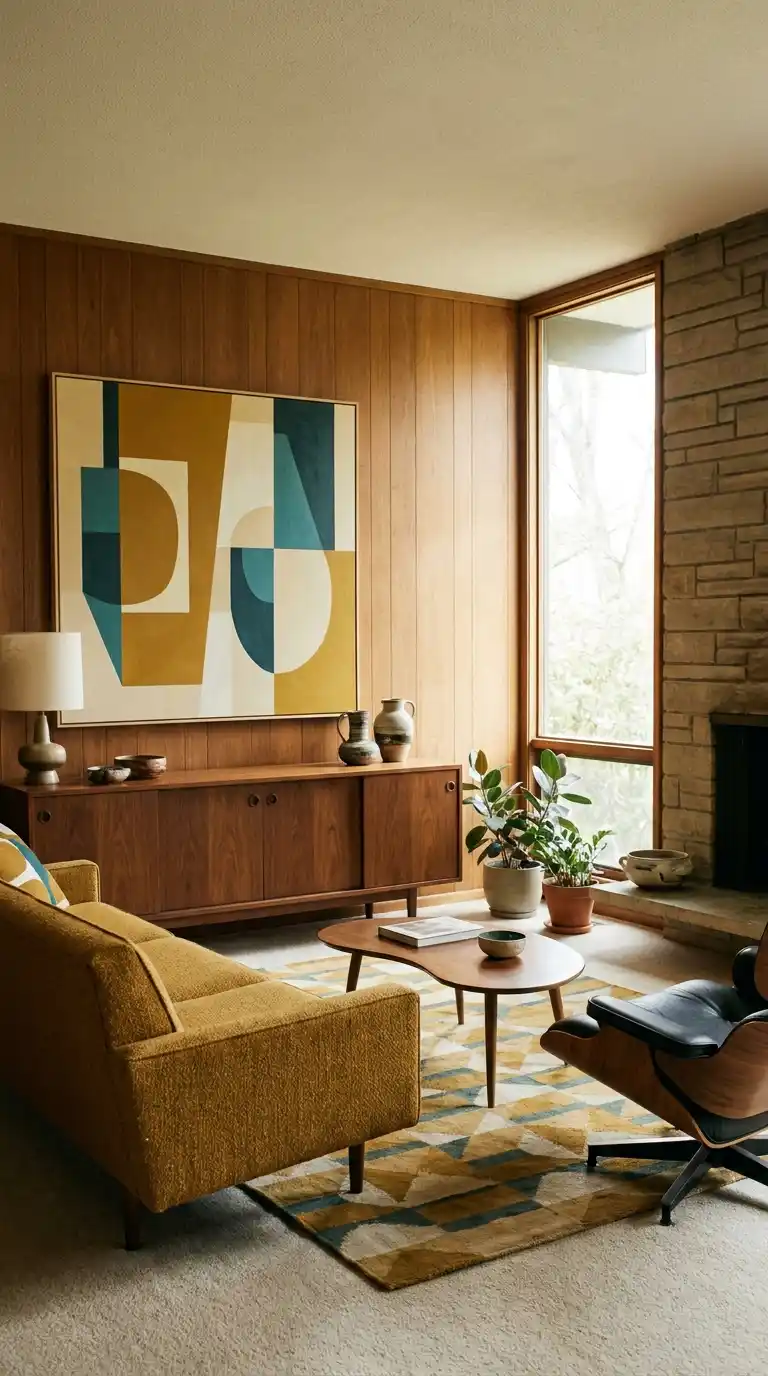
Large-scale abstract art with bold color blocking and geometric shapes complements mid-century furniture’s clean lines while introducing the era’s characteristic warm, saturated color palette.
Hang the piece above a credenza or sofa at a size proportional to the furniture beneath it, generally covering about two-thirds of the furniture’s width for the most balanced composition.
Best suited for: living rooms wanting a strong focal point above a credenza or sofa without adding another furniture piece.
14. Indoor Plants in Ceramic Planters
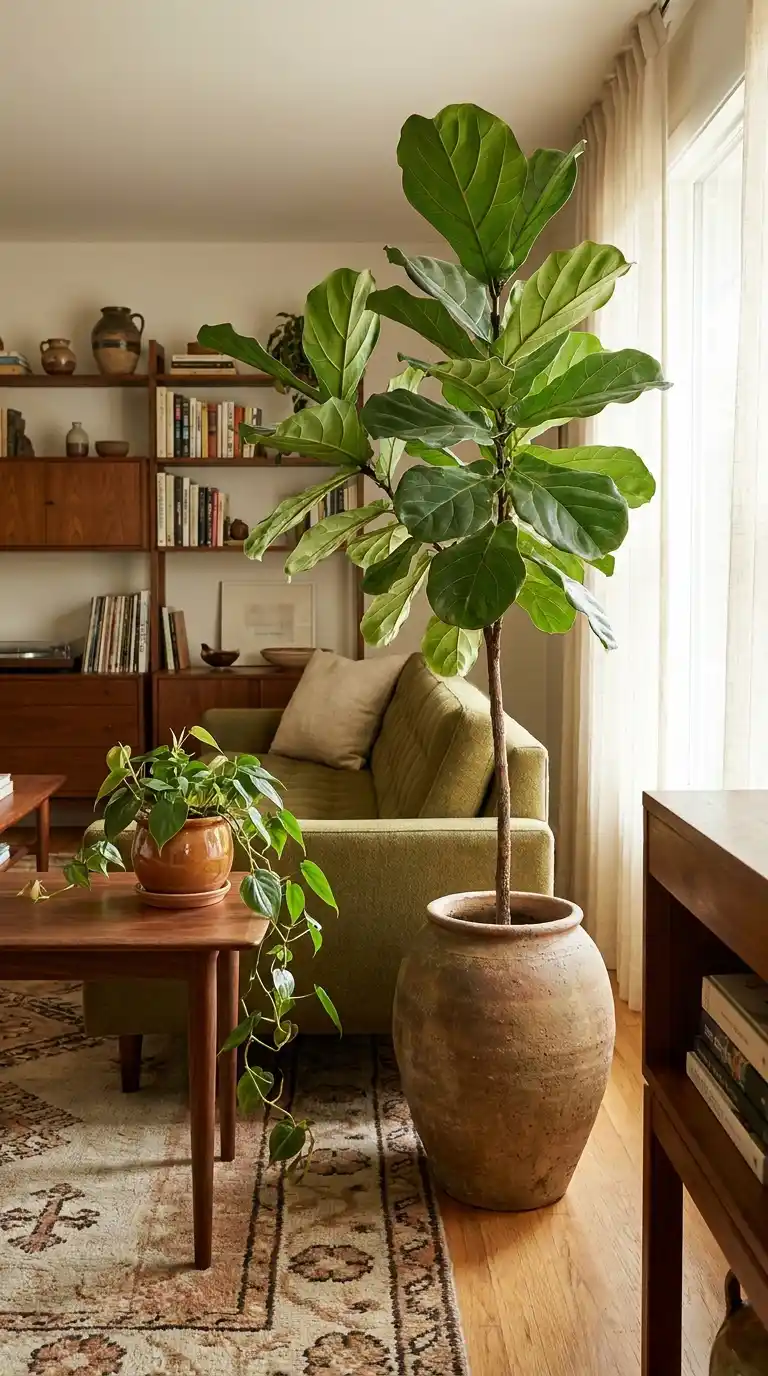
Mid-century design has long paired well with indoor plants, since the organic greenery softens the style’s clean lines and geometric patterns, and mid-century-style ceramic planters add another layer of period-appropriate texture.
Choose planters in warm, earthy glazes like burnt orange, olive, or cream rather than stark white or black, keeping the pots consistent with the room’s broader warm color palette.
Best suited for: any mid-century living room, and especially rooms with strong natural light to support larger plants.
15. Wood Slat Room Divider
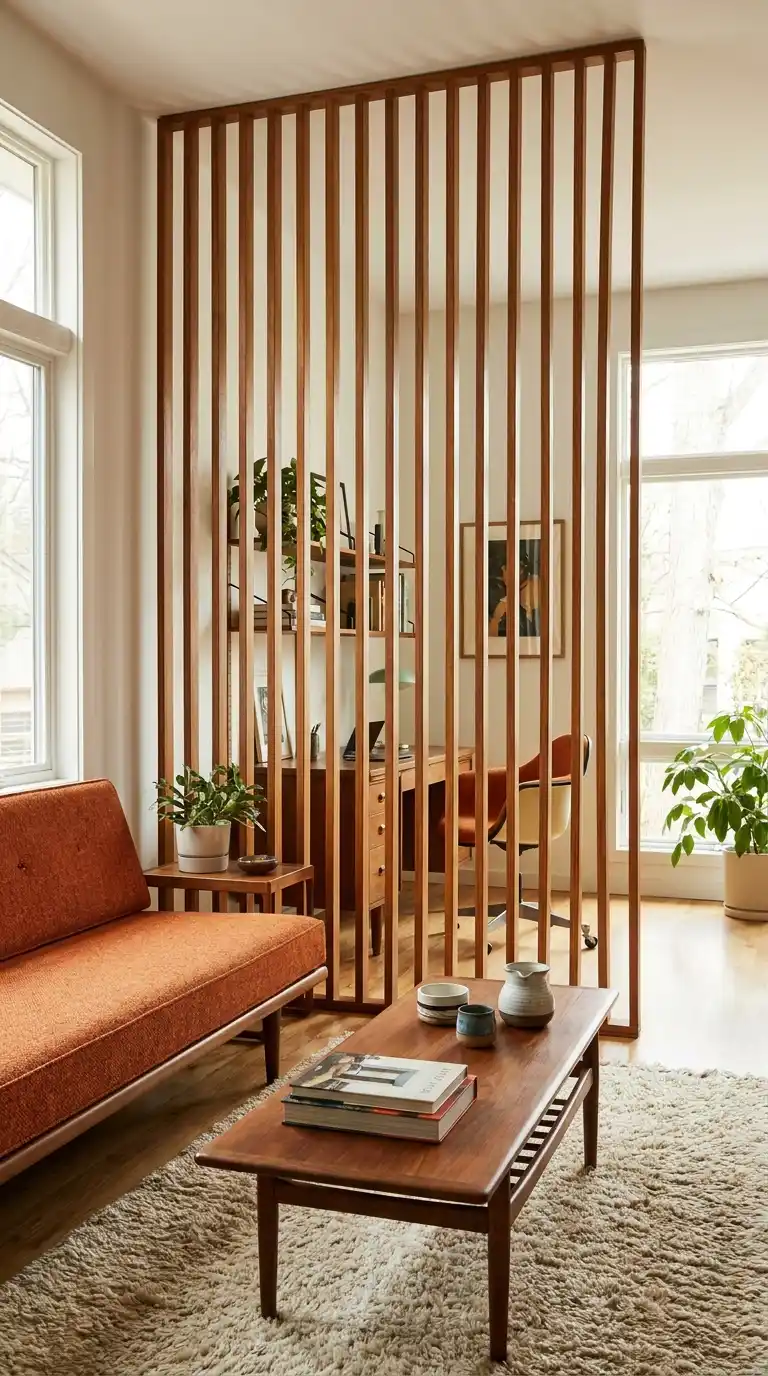
A wood slat room divider brings mid-century texture into a functional room-dividing piece, letting light and sightlines pass through while still visually separating two zones within an open-plan space.
Choose a divider height that partially obscures but does not fully block the secondary space, since the mid-century aesthetic favors openness and light over fully closed-off rooms.
Best suited for: open-plan living rooms that need to visually separate a seating area from a workspace or dining area.
16. Brass and Gold Accent Hardware
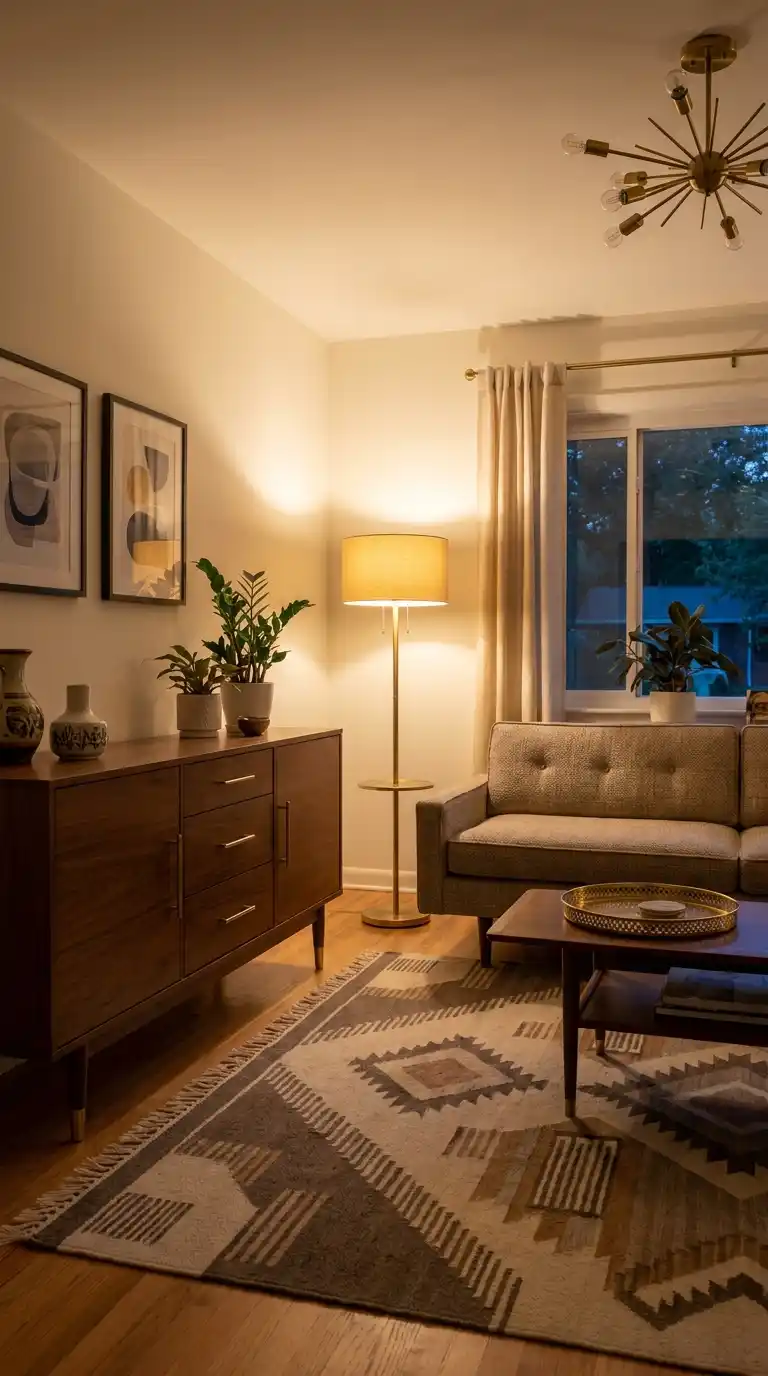
Small brass or gold hardware details on lamp bases, drawer pulls, or table legs add a subtle metallic warmth that complements mid-century wood tones without overwhelming the room’s overall palette.
Repeat the metal finish across at least two or three items in the room, such as lighting, hardware, and a decor accent, so the detail feels intentional rather than a single isolated element.
Best suited for: living rooms wanting a refined finishing touch after the major furniture pieces are already in place.
17. Retro-Inspired Pendant Lighting
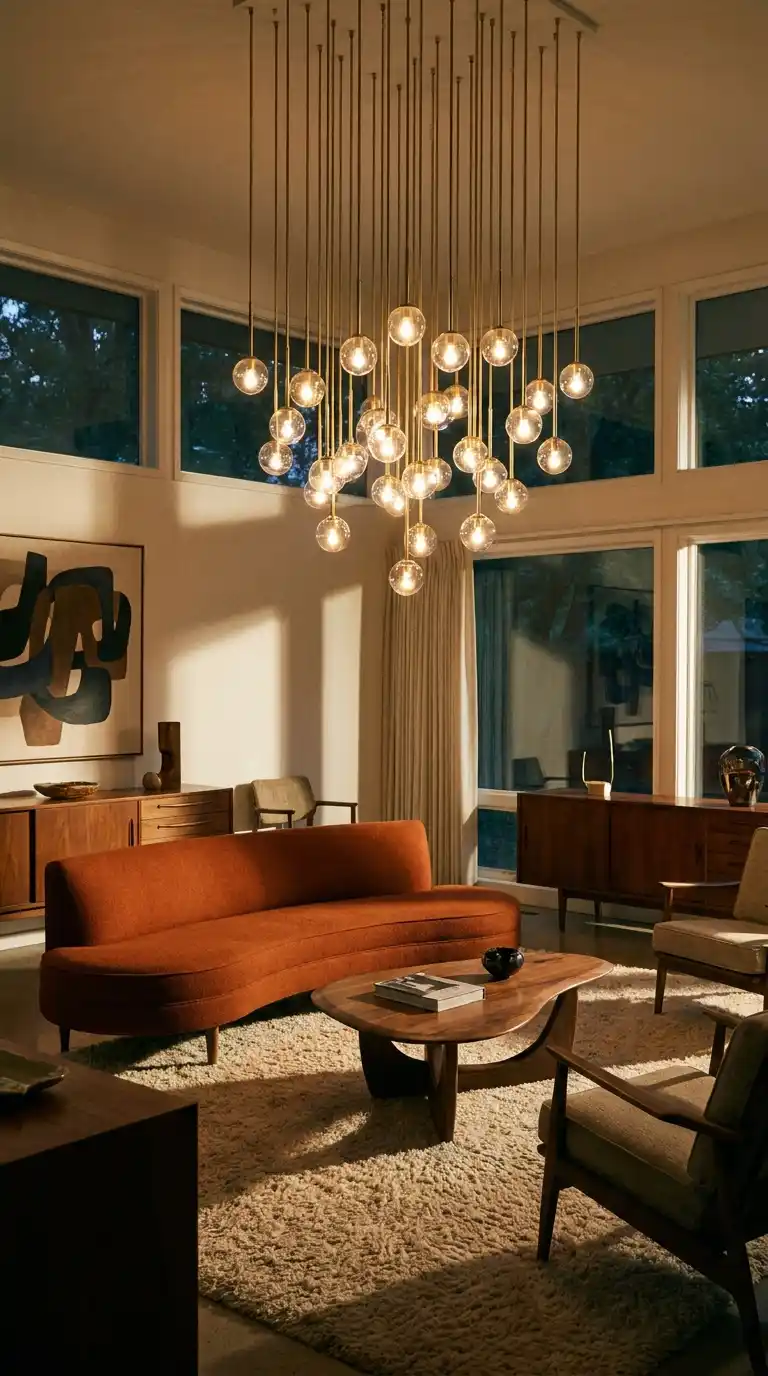
Retro-inspired pendant lighting, particularly small globe or drum shades on brass stems, brings period-appropriate lighting design into the room without relying on floor or table lamps alone.
Hang a small cluster of pendants at staggered heights over a seating area for a more dynamic look than a single centered fixture, echoing the sculptural quality found in mid-century lighting design.
Best suited for: living rooms with ceiling height and existing electrical support for a hanging fixture.
18. Statement Eames-Style Lounge Chair
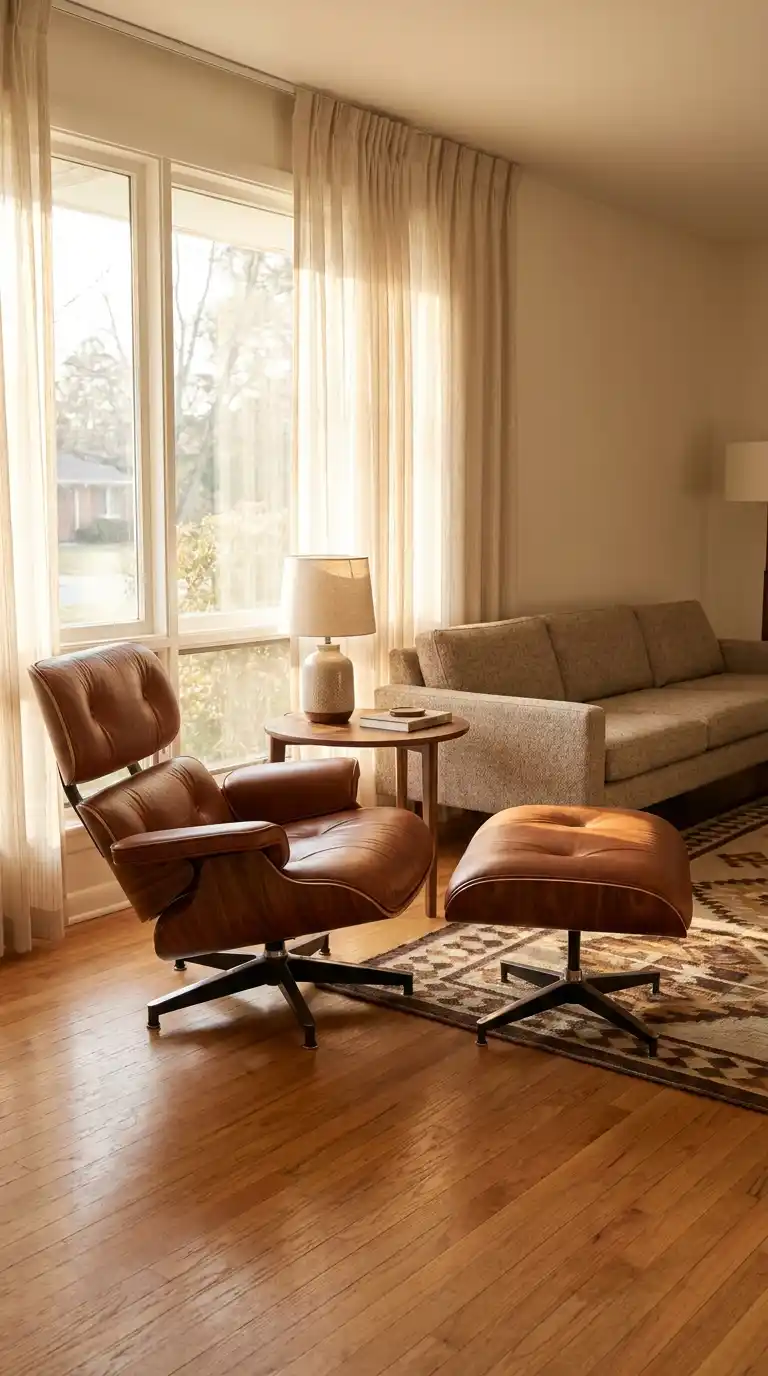
A leather and walnut lounge chair with a matching ottoman is one of the most recognized pieces of mid-century furniture design, and even a well-made reproduction brings genuine style credibility to a room.
Position the chair near a window or reading nook rather than as part of the main conversational seating group, letting it function as a dedicated reading or relaxation spot.
Best suited for: living rooms with room for a dedicated single-seat reading area, and anyone wanting one true investment furniture piece.
19. Styled Media Console With Vintage Touches
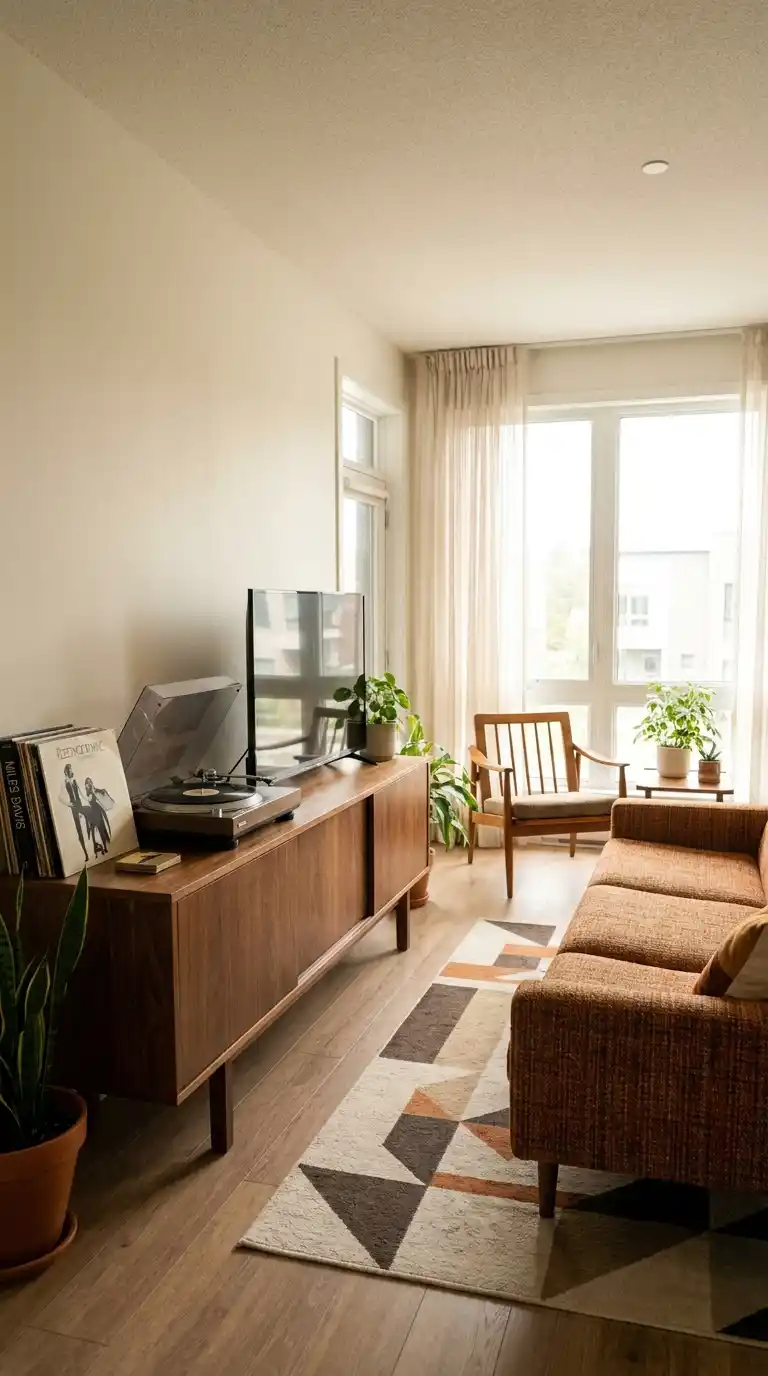
Styling a media console with a vintage-inspired record player or a curated stack of records adds a nostalgic, functional decor element that fits naturally into the mid-century aesthetic without feeling like a pure prop.
Keep the console styling balanced between the necessary modern electronics and the vintage decor touches, so the space feels current and livable rather than a period recreation.
Best suited for: living rooms with a dedicated media console and anyone who genuinely enjoys vinyl or vintage audio equipment.
20. Curated Gallery Wall of Mid-Century Art
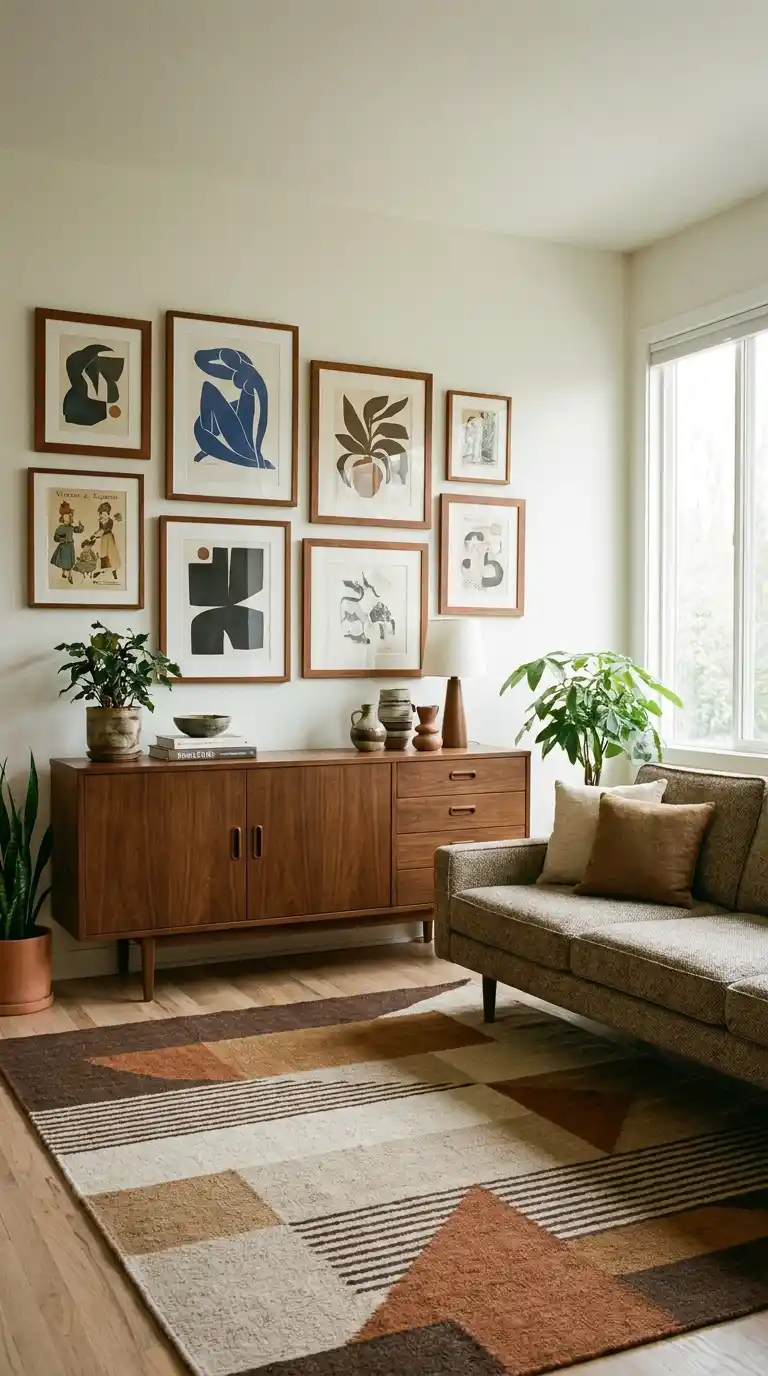
A gallery wall built from mid-century-style abstract prints and vintage illustrations gives a room a personal, collected quality while reinforcing the era’s characteristic color palette and geometric shapes.
Use consistent warm wood frames across the gallery wall rather than mixing several frame colors, since frame consistency is what pulls a varied print collection together into one cohesive display.
Best suited for: living rooms with a secondary wall for display and anyone wanting a personal, curated finishing touch to the room.
Planning and Buying Tips
A few practical decisions up front will help you build a mid-century modern living room that feels authentic rather than assembled from disconnected trend pieces.
● Start with one or two investment pieces — a quality sofa or lounge chair sets the tone for the room and is worth prioritizing over filling every corner with smaller items immediately.
● Standard sizing to shop for — mid-century sofas typically sit 30 to 32 inches tall at the back, noticeably lower than the 34 to 3838-incheight common in many contemporary sofas.
● Check wood tone consistency across major pieces — walnut, teak, and oak all appear frequently in the style, but mixing too many different wood tones in one room can undercut the cohesive look.
● Verify authenticity claims when buying vintage — ask for maker’s marks, provenance, or documentation before paying premium prices for pieces advertised as original mid-century designs.
● Balance vintage and new pieces — mixing a few authentic or high-quality vintage finds with well-made reproductions keeps costs manageable without sacrificing the room’s overall authenticity.
● Plan lighting in layers — combine ambient ceiling or pendant lighting with a floor lamp and table lamp, since mid-century rooms typically rely on multiple warm light sources rather than a single overhead fixture.
Cost Breakdown: Budget, Mid-Range, and Luxury Approaches
Mid-century modern living rooms can be built with budget reproductions, mid-tier quality furniture, or authentic vintage and designer pieces, with a significant cost range between the three approaches.
Budget ($300–$1,500)
Budget reproduction furniture, retro-patterned textiles, a geometric rug, and decor accents like a sunburst mirror fall in this range. Assembly is typically DIY with no installation cost beyond delivery fees.
Mid-Range ($1,500–$6,000)
Quality reproduction sofas and lounge chairs, a solid walnut credenza, and retro-inspired pendant lighting sit in this tier. Basic lighting installation may add $100–$300 if hardwiring a new pendant fixture.
Luxury / Premium ($6,000–$20,000+)
Authentic vintage designer furniture, custom wood slat paneling, and a fully curated room of period-correct pieces fall here. Sourcing authentic vintage pieces often adds significant time and sometimes restoration costs of $200–$1,000 per piece on top of the purchase price.
Furniture and Sourcing Comparison
| Approach | Price Range | Authenticity | Sourcing Time | Best For |
| Budget reproduction furniture | $150–$800 per piece | Low | Low — widely available online | Renters, first-time mid-century rooms |
| Quality reproduction furniture | $800–$3,000 per piece | Moderate | Low to moderate | Long-term homeowners wanting durability |
| Authentic vintage furniture | $1,000–$10,000+ per piece | Very high | High — requires searching and vetting | Collectors and design purists |
| Decor accents (mirrors, art, textiles) | $20–$300 each | Varies by source | Low | Quick style updates on any budget |
| Custom wood slat paneling | $500–$3,000+ | High if solid wood used | Moderate — often professionally installed | Architectural, full-room commitments |
| Retro-inspired lighting | $100–$800 per fixture | Moderate to high | Low to moderate | Rooms needing both function and style |
Maintenance Tips
● Wood furniture — dust regularly with a soft cloth and use furniture polish or oil formulated for walnut or teak every few months to maintain the wood’s natural warmth and prevent drying out.
● Upholstered pieces — rotate and fluff cushions regularly to maintain shape, and address spills immediately with a fabric-appropriate cleaner to prevent staining on lighter retro-colored upholstery.
● Vintage pieces — handle vintage upholstery and wood with extra care, since original finishes and fabrics are often more delicate than modern reproductions and can be costly or impossible to replace exactly.
● Brass and metal accents — polish brass hardware periodically if you prefer a bright finish, or leave it unpolished if you prefer the warmer, natural patina that develops over time.
● Rugs — vacuum regularly and rotate every six months if in direct sunlight, since bold geometric rug patterns can show uneven fading more noticeably than solid-colored rugs.
● Common mistake to avoid — over-restoring or refinishing a genuinely valuable vintage piece, which can significantly reduce its value compared to preserving the original finish with proper cleaning alone.
Frequently Asked Questions
What defines mid-century modern living room design?
Mid-century modern design is typically defined by clean lines, low-profile furniture with tapered legs, warm wood tones like walnut and teak, organic shapes, and a color palette that includes warm, saturated tones such as mustard, teal, and burnt orange.
What colors are best for a mid-century modern living room?
Classic mid-century palettes favor warm, earthy tones like mustard, olive, burnt orange, and teal, typically paired with warm wood furniture and neutral wall colors as a backdrop for those accent colors.
How do I make a room look mid-century modern on a budget?
Focus on a few defining elements first, such as a low-profile sofa with tapered legs, a geometric rug, and one bold accent piece like a sunburst mirror, rather than trying to source every item as an authentic vintage find.
Is mid-century modern furniture a good investment?
Authentic, well-documented mid-century designer furniture has historically held or increased in value over time, though quality varies significantly, so verifying maker’s marks and provenance matters more than the style label alone when buying as an investment.
Can mid-century modern work with other design styles?
Yes — mid-century modern pieces mix well with Scandinavian, transitional, and eclectic styles, since the clean lines and warm wood tones tend to complement rather than clash with other minimalist or organic-modern design elements.
How to Choose the Right Mid-Century Modern Elements for You
The right combination of ideas depends on three factors: your budget, how much you value authenticity versus reproduction furniture, and how fully you want to commit to the style throughout the room. A smaller budget is well served by starting with textiles, a rug, and one accent piece, while a larger budget allows for investment furniture and even authentic vintage sourcing.
Space also matters — the style’s low-profile furniture and clean lines work especially well in smaller rooms where bulkier contemporary furniture can feel overwhelming, but the same elements scale up comfortably in larger spaces with the addition of more statement pieces.
Finally, decide early how strictly you want to follow the style. Many of the most successful mid-century modern living rooms mix a few true-to-era pieces with more contemporary or personal items, rather than recreating a period room exactly.


- Be Respectful
- Stay Relevant
- Stay Positive
- True Feedback
- Encourage Discussion
- Avoid Spamming
- No Fake News
- Don't Copy-Paste
- No Personal Attacks
- Be Respectful
- Stay Relevant
- Stay Positive
- True Feedback
- Encourage Discussion
- Avoid Spamming
- No Fake News
- Don't Copy-Paste
- No Personal Attacks
